How to Run GPT-6 Astra in Hermes — and Why It Is Missing From Your /model List
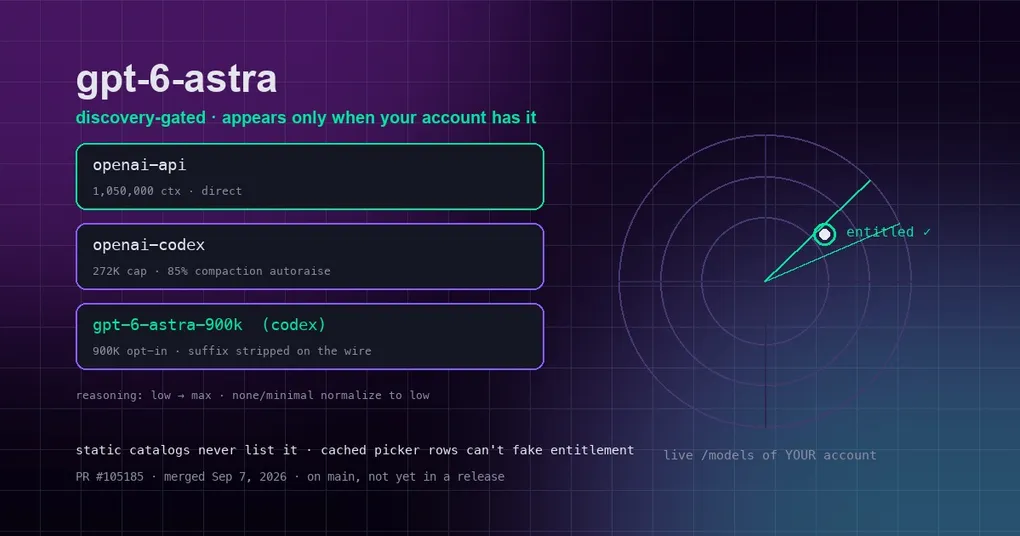
OpenAI shipped GPT-6 Astra on September 3 — its first GPT-6-generation flagship, billed as its most capable and aligned model yet — and within hours X and Hacker News were full of benchmark screenshots. You open Hermes’ /model picker to switch over, scroll the list twice: gpt-5.6-sol is there, gpt-5.4 is there, but there is no gpt-6-astra anywhere. Before you suspect a broken install, know this: it is deliberate. Hermes treats Astra as a discovery-gated model, and that mechanism is exactly why its picker is more honest than a static catalog. Here is what Astra is, why it is “missing,” and what the 272K / 900K / 1.05M window numbers actually mean.
Sixty seconds on Astra
GPT-6 Astra is OpenAI’s first model in the GPT-6 generation, a single dense model with no mini/nano split. Official specs: a 1,050,000-token context window, 128,000 max output tokens, a knowledge cutoff of April 30, 2026, and five reasoning-effort settings from low to max. Its focus is squarely agentic: computer use, long-horizon coding, multi-step tool workflows. OpenAI self-reports 72.6% on OSWorld 2.0 — a benchmark where the model drives a real operating system to complete tasks — against 65.7% for GPT-5.6 Sol, roughly at the human baseline. Note those scores are OpenAI’s own; independent replication is still catching up.
The pricing is flagship-grade too: $10 per million input tokens, $50 output, $1 cached input, $12.50 cache writes, plus a roughly 2× “fast” priority tier. And OpenAI is rolling it out in waves — Trusted Access enterprises first, with ChatGPT Plus/Pro/Business/Enterprise and API access following over the next days. If your account has not been enabled yet, that is the most common reason Astra is nowhere to be seen.
Why it is missing from /model: discovery gating
Hermes handles Astra differently from every previous model: it does not exist in the static catalog. In the past, a new model meant a new line in Hermes’ offline model list, visible in /model immediately. Astra takes another path — discovery gating:
- Every time you open the
/modelpicker, Hermes performs a live discovery call to the provider’s/modelsendpoint for your account;gpt-6-astraappears only if OpenAI’s response actually contains it. - Cached picker rows, your saved “current model,” even the unauthenticated catalog skeleton — none of them can fabricate that entitlement. If a refresh fails, the fallback removes Astra from the list rather than leaving a row that errors out the moment you click it.
So a missing entry is not Hermes lying to you with a generic world-catalog — it is a faithful mirror of what your account can actually do right now. The day OpenAI enables you, nothing needs configuring: reopen the picker and it is there. The design landed in PR #105185, merged September 7, which also fixed a bug where every direct-API Astra request raised a TypeError from an unsupported cache parameter.
Three routes, three windows
The same Astra model exposes very different usable context windows depending on the route you connect through:
| Route | Model id | Window | Notes |
|---|---|---|---|
| OpenAI direct API | gpt-6-astra |
1.05M | pay-per-token, largest window |
| ChatGPT subscription (Codex OAuth) | gpt-6-astra |
272K | hard cap on the Codex backend |
| Codex OAuth, explicit opt-in | gpt-6-astra-900k |
900K | picker alias, see below |
| OpenRouter | openai/gpt-6-astra |
1.05M | plus -fast / -flex / -pro tiers |
The recurring confusion is the second row: if the official spec says 1.05M, why does the Codex subscription route cap at 272K? Because Codex (the chatgpt.com/backend-api/codex route) enforces its own hard context limit, and Hermes’ local metadata resolves Astra there to 272K — a route limit, not a model limit. Our Codex context-window deep dive already dissects this mechanism: Hermes once auto-raised Codex slugs to the verified 900K window, watched subscription usage burn through, and reverted to “base slug = advertised 272K, 900K is an explicit opt-in.”
The -900k variant in row three is that opt-in applied to Astra: it is a Hermes-side picker alias whose suffix is stripped before the request goes on the wire — OpenAI sees plain gpt-6-astra — while Hermes manages the session against a 900K window. The window is real and measured: the project source records a live test from September 4 where a 920,043-token input succeeded and a 1,000,043-token one was rejected.
Switching: commands and picker
Making Astra your default model, or just trying it once, is plain CLI work:
# Direct OpenAI API (your account needs Astra enabled for the API too)
hermes chat --model gpt-6-astra --provider openai-api

# ChatGPT subscription via Codex OAuth: base 272K window
hermes chat --model gpt-6-astra --provider openai-codex

# Same subscription, explicit 900K window
hermes chat --model gpt-6-astra-900k --provider openai-codex
Inside a session, hit /model to open the fuzzy picker (the one living in the Ctrl+P command palette) and type astra to filter; hermes model sets your default. On reasoning effort, Astra accepts low / medium / high / xhigh / max; none and minimal are normalized to low on the official routes, because OpenAI’s API rejects “disable thinking” requests for it. For everyday work low or medium keeps the token bill down without feeling slow.
272K is not just a cap — it is a billing cliff
Why doesn’t Hermes default subscription users to 900K? Because for OpenAI, 272K is a whole-request pricing threshold: once a single request exceeds 272K tokens, the entire request — not just the overage — is repriced at the higher tier. Input jumps from $10/M to $20/M, output from $50/M to $75/M, cached input from $1/M to $2/M. Cross 272K and that one call’s bill doubles, instantly. On the Codex subscription route it gets worse: every tool call re-reads the accumulated context, so cache-read cost grows linearly with the window.
“Base slug defaults to 272K” is therefore not a crippled feature — it is the engineering decision Hermes made after getting burned: defaults should save money for the many, not maximize comfort for the few. When a task genuinely needs a whole repository or a full day of session history in view, switch to -900k explicitly and pay the higher unit price for that window. It is a trade, and now you know which side of it you are on.
When compaction kicks in: the 85% autoraise
A bigger window does not mean you can fill it to the brim — Hermes auto-compacts (distills the middle of the history into a summary) at a trigger point, by default 50% of the window. The problem: Astra on the Codex route only has 272K, so a 50% trigger would compact at ~136K — far too early for a flagship that can hold 1.05M, and a waste of its long-horizon strength.
Hermes therefore raises the compaction trigger for Codex-route Astra (and its gpt-5.4/5.5/5.6 siblings) to 85% — roughly 231K — so the session runs almost to the edge of the 272K window before summarizing. The -900k alias and other routes (direct API, OpenRouter) are unaffected and keep the global 50%. If you prefer the old behavior, the config key codex_gpt55_autoraise (a historical name; default true) turns it off, and codex_gpt55_autoraise_notice controls the one-time banner.
Current status: on main, waiting for the next release
One honest caveat on “can I use it today”: the Astra integration merged to the main branch on September 7 (PR #105185 plus the companion compaction fix #104762) and is not in any released version yet — the v0.21.0 Pantheon release from August 31 predates it. When the next release ships, a single hermes update gets it; early adopters can run a dev build or build from source. And remember the precondition: your OpenAI account must be enabled for Astra first. If you cannot see it right now, the most likely explanation is not a broken Hermes — OpenAI simply has not gotten to your account yet. Give it a few days and reopen /model.
In one sentence: Astra is Hermes’ first discovery-gated model — not seeing it in the list means your account lacks access, which is the picker being honest with you — and the “272K default + 85% autoraise” pairing is Hermes balancing saving your money against using the model’s full capability.