A "patch release" you would skip — v0.23.2 rolls in 1,989 PRs and says so plainly
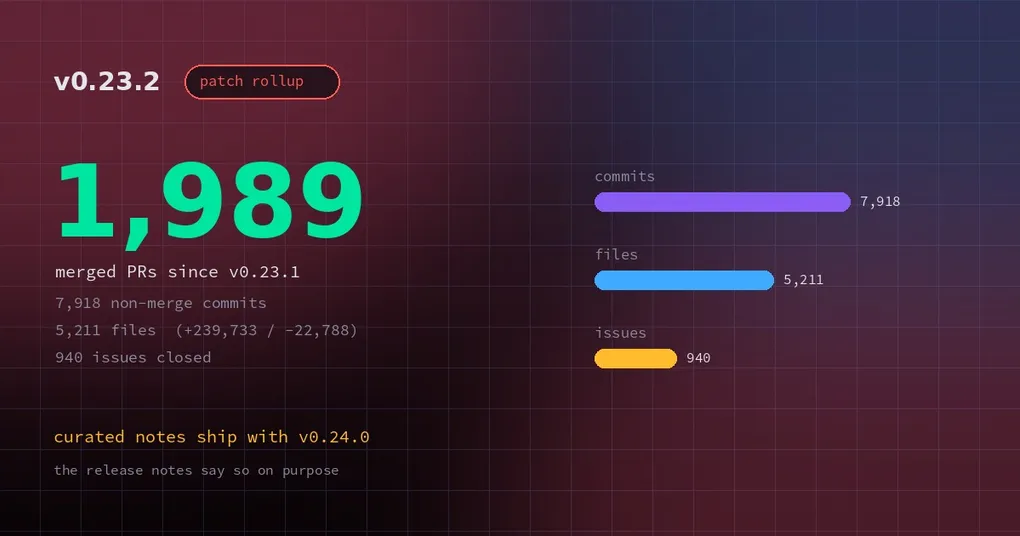
You scan the release list in the morning, see v0.23.1 turn into v0.23.2 with “Patch release” in the title, and move on. For most projects that is the right call. For this one it would be a mistake — because this time the version number moved one decimal place and the window behind it holds roughly 1,989 merged PRs.
What makes it unusual is the notes themselves: they say outright that most of the window is undocumented here on purpose, and that the full curated notes ship with v0.24.0. So this is not a translation of the release page. It is a plain account of what is documented, what got one sentence, and what “upgrade now” actually means.
First, the size of this “patch”
Official numbers, measured at commit ae2a81ccc00:
| Metric | Value |
|---|---|
| Merged PRs | ~1,989 |
| Non-merge commits | 7,918 |
| Changed files | 5,211 (+239,733 / −22,788) |
| Issues closed | 940 |
For comparison, the v0.23.1 patch window was ~618 PRs and 2,578 commits. This one is more than three times that. It is still called a patch release because of its job, not its size: it exists to roll the window into a stable tag for the GitHub release (CLI and installers), the Microsoft Store app, Docker and Hermes Cloud.
Why wait for v0.24.0 to document features? The stated reason is that curation takes time and that v0.24.0 covers everything from v0.23.0 onward, with nothing in the window skipped. That is fair, but it leaves you with a practical question today: is it worth upgrading before the write-up exists?
The seven fixes the notes do document
These are the ones listed under “Fixed in the release candidate”:
- Desktop chats that could not send. Created by an August build with a bare
customprovider, they were stuck. After updating, they send again (#156545). - The Stop button that never went away. In Desktop or the TUI, a reply that streamed beside a todo or memory call never settled. It does now (#156553).
- The duplicated “Recovered reply”. After a mid-stream crash on Telegram and other edit-streaming chats, the reply appeared twice. A related fix: a word carrying a key prefix mid-word (
program_id) was hidden and now shows on time (#156546). - Typed text eaten at cold start. While Desktop starts and resumes your last chat, what you type could be lost or scrambled. Two fixes landed for that (#156615, #156642).
- The reply drawn twice after a reconnect. Reconnecting mid-reply re-rendered the stored reply, attachments included. Now it shows once, in full (#156611).
- The wrong sign-in prompt. In the Webapp, opening Hermes Cloud agents while this install was not signed in to Nous Portal pointed at the Webapp login instead. It now says to sign in to Nous Portal, and answers 409 rather than 401 (#156652).
- A leftover
gitprocess. Exiting the CLI while its startup update check was waiting on GitHub leftgit ls-remoterunning. It dies with the CLI now (#156616).
If you use the desktop app, items 2, 4 and 5 are the “once a day, at least” class of bug. Those three alone justify the update.
The capabilities that got one sentence
The notes list a dozen things in a single paragraph, and each one is its own article. Four matter most for daily use:
Desktop finally has backup and migration. Settings ▸ Backup & Transfer is two cards: one writes the entire agent to a zip (every profile, settings, memory, skills, schedules, chats, .env, auth.json), one installs that zip into a cloud agent you choose. It uses ordinary hermes backup plus hermes import --keep-host — no private migration format — takes an undo point before replacing anything, and names the files it could not restore when a restore fails. The deep version is in backup and cloud transfer.
The fallback chain can be examined. hermes fallback check starts no session; it checks config and credentials per entry, and --live sends one real minimal request, catching exhausted quota, retired models, 502s behind an endpoint, and the quiet case where a provider answers with a different model than you asked for. Any entry that is not ready exits 1. Full walkthrough: fallback chain health check.
Subagents survive a restart. Every child keeps a durable record in state.db, its worktree stays pinned (48 hours by default), and resume_mode explains why it stopped. Continue it by hand with delegate_task(action='continue'), or turn on delegation.auto_resume and let the gateway resume due children every 15 seconds. Details in subagent automatic resume.
Cron delivery is now per job. --no-wrap-response drops the Cronjob Response: ... header and the closing note; --attach-to-session turns a brief into a conversation you can reply into, and a Telegram topic job can open a fresh thread per run with cron_fresh_thread_per_run; catch_up, grace_minutes and timezone are per-job too. Details in cron delivery switches.
Also in the window: one prompt-cache clock per session, hermes update --force (stop gateways at once instead of draining), one-time browser_vault codes entered from Telegram and Discord, opt-in shared Telegram DM threads, the Gemini Interactions API by default for Gemini 3 and later plus Gemini 4 Carbon, fast mode for Claude Mythos 5.2, new plugin APIs (ctx.fork_session, ctx.redact_text(), ctx.register_idle_task), and a slimmer macOS bundle that installs Chromium on first use.
Three of those we have already covered separately: the prompt-cache clock, vault codes in chat, and plugin fork_session.
Should you upgrade now?
Three honest cases.
Heavy desktop users: yes. Items 2, 4 and 5 above are direct interface pain, and the desktop also gains the backup page. One caveat: a desktop installed from the .exe / .dmg installer does not change in this release — it updates with the next bundled release. The Microsoft Store app updates through the Store.
CLI and server users: yes, with two checks first. Run hermes fallback check (is the chain real?), and if you depend on scheduled jobs, run hermes cron doctor and decide whether key jobs deserve --no-wrap-response or --attach-to-session. Neither changes behaviour; both tell you where you stand.
Docker and Hermes Cloud: pull stable or latest as usual. Nothing here needs a manual migration.
One caution: --live sends real requests — one minimal call per entry, tiny but not free. Do not put it in a loop that runs every minute.
The short version
“Patch release” here means “the tag release”, not “the empty one”. The suffix moved one digit and the window holds 1,989 PRs across 5,211 files, including four things the notes mention in a single sentence and that change how the thing feels every day. The official write-up arrives with v0.24.0; until then, these articles fill the gap.
Full entry list: v0.23.2 release page.