Third tag in eleven days: v0.23.3 rolls in 370 PRs and documents almost none of them
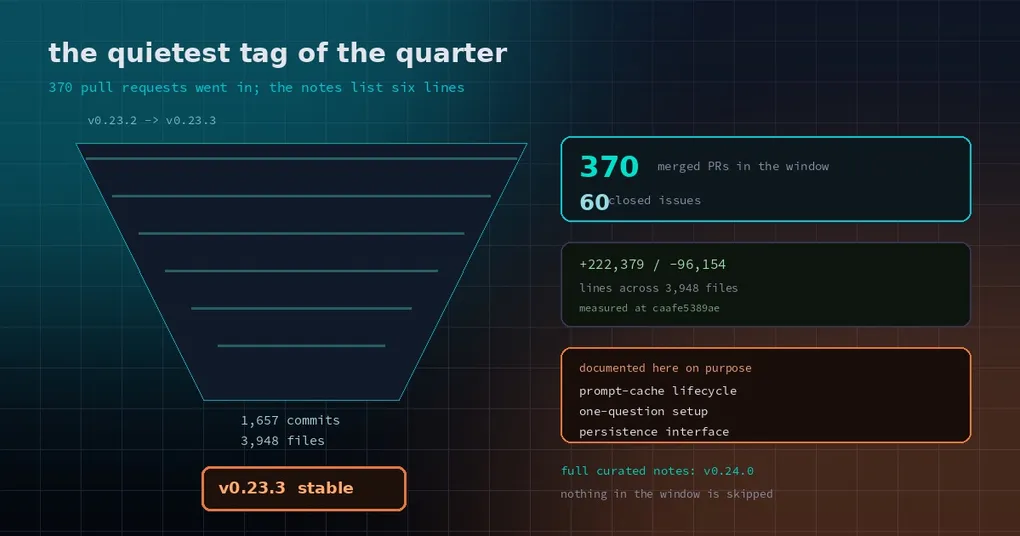
You open the release list with coffee, see that v0.23.2 has become v0.23.3 four days later, read the words “Patch release”, and close the tab. For most software that is the correct instinct: a patch number means a handful of fixes you will pick up the next time you update anyway. This project has spent the last few months making that instinct unreliable, and this release is a good example of why — the tag is small, the window behind it is not, and the release notes tell you outright that they are leaving most of it out.
So this is not a translation of the release page. It is what the numbers actually say, which parts of the window the notes do name, and what “should I update” looks like when the changelog is deliberately incomplete.
370 PRs in four days is not a small window
The tag was published on November 20, 2026 at 00:34 UTC, four days after v0.23.2. Measured at commit caafe5389ae, the official release body counts:
| Metric | v0.23.2 window | v0.23.3 window |
|---|---|---|
| Merged PRs | ~1,989 | 370 |
| Non-merge commits | 7,918 | 1,657 |
| Changed files | 5,211 | 3,948 |
| Lines | +239,733 / −22,788 | +222,379 / −96,154 |
| Closed issues | 940 | 60 |
The first thing that jumps out is the ratio. Last window, a merged PR was worth about 120 added lines on average. This window, it is closer to 600 — and the deletions are four times heavier too. That is not a sign of sloppiness; it is the shape of a few very large refactors rather than a long tail of small features. The two candidates in the notes point the same way: the storage layer was split behind a persistence interface with SQLite as its backend, and compaction learned to archive the tool results it drops instead of discarding them.
The second thing worth noticing is the size of the tag itself. Four days, 370 PRs, and the release is labelled a patch. Whatever your opinion of that versioning scheme, it means one practical thing: if you are on v0.23.2, you are now four days and several hundred changes behind the stable tag.
The list the notes say they are skipping is the interesting one
The release body is unusually direct. It says that these items are “undocumented here on purpose”, and that the full curated notes ship with v0.24.0. Here is what that list actually contains, in the order it is given:
- A prompt-cache lifecycle controller. Caches are kept warm through long tool runs, idle chats are compacted before the one-hour cache window expires, and Nous Portal sessions get the full one-hour lifecycle. The setting behind it is
prompt_caching.cache_ttl, which defaults toauto— the values areauto,5mand1h. We wrote about that one separately in the prompt-cache lifecycle guide. - A one-question first-run CLI setup with the free tier. Five screens became one, and a fresh install can start on the free tier with no account. That has its own write-up in the
hermes setupguide. - Compaction that archives what it drops, plus a proactive tool-result prune that is now on by default. This is the one with the largest effect on long sessions: the context window stops being a one-way shredder.
- A persistence interface under the storage layer, with SQLite as one implementation behind it. Architecture, not a feature — but it is what most of the added-and-deleted line count above is.
- Also, in a single sentence each: the “Waiting on teammates” strip above Bot Chat composers, the Linux AppImage running the agent payload from a stable per-build copy, security bumps for oauthlib, opentelemetry and tornado, a batch of new plugin-catalog entries, and GPT-6.2 Astra and Sol (plus Pro) on OpenRouter and Nous Portal.
Notice what is missing from the prose: no migration steps, no “breaking” section, no list of behavior changes you are supposed to read before upgrading. For a tag this size that is a real gap, and it is the honest reason to read the source comparison rather than the notes if you depend on something specific in this window.
If you want the release-page version of all of this, the site’s own v0.23.3 release page follows the same structure as the previous tags.
What this rhythm means for you
Three tags in eleven days — v0.23.1 on November 9, v0.23.2 on the 16th, v0.23.3 on the 20th — with the curated notes deferred to v0.24.0, tells you how the project intends to work now: small stable tags go out often so that CLI, installers, the Microsoft Store app, Docker and Hermes Cloud all sit on the same commit, and the readable documentation arrives on a slower cadence.
That is fine as a release process and mildly annoying as a user. The practical rule is to stop treating the patch number as a proxy for “safe to ignore” and instead decide by what you depend on:
- If you use MCP servers, this window matters: a server that can never start used to be retried four times every five minutes forever, which is expensive in
npxcache and CPU. That fix is described in the MCP respawn write-up. - If you run more than one profile behind a gateway, the credential-isolation work in this window is worth having; the details are in the Modal sandbox credential post.
- If you use the vault for logins, the fill path changed in ways that are visible from the outside — see the vault fill hardening post.
- If you only use the CLI for chat, you can wait for v0.24.0 without missing anything you will notice, apart from the cheaper prompt-cache behaviour.
One practical detail from the release body that saves a support thread: the desktop app installed from the .exe / .dmg installer does not change in this release. It updates with the next bundled release. Only the Microsoft Store build follows the Store, and Docker / Hermes Cloud follow the image tag.
Upgrading
hermes updateOr re-run the installer one-liner if your update path is stuck. Docker and Hermes Cloud want nousresearch/hermes-agent:stable (or :latest). If you are installing fresh, the install page has the current one-liner, and the first run will now ask you a single question instead of five.
A patch tag with 370 pull requests is not a quiet week. It is a quiet announcement of a busy week — and the difference matters the next time you decide to skip one.