One memory slot, four backends: Comemo stacks Honcho, Mem0 and Supermemory
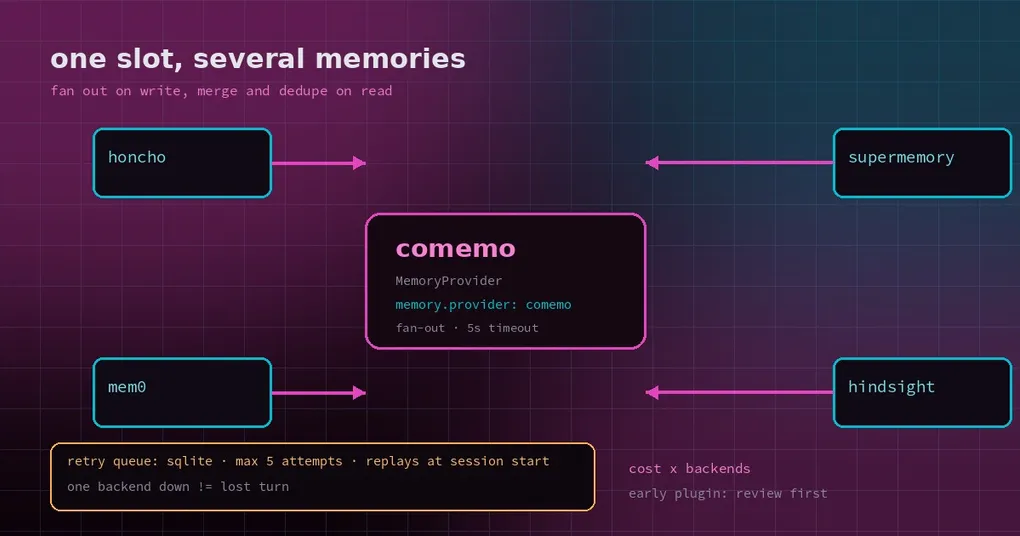
You are juggling three things at once: a client’s business system, an open-source library you maintain, and a pile of throwaway scripts. Honcho remembers the client’s preferences and how people relate to each other. Mem0 extracts facts from conversations automatically. Supermemory is good at document retrieval. There is just one problem — Hermes has a single memory slot. Pick Honcho, and the other two stop receiving anything.
That is not a misconfiguration. The docs are explicit: exactly one external memory provider can be active at a time, while the built-in MEMORY.md and USER.md always keep working alongside it. The discussion in the core repo (issue #24770) has been open a long time, with the conclusion that a composite belongs in a plugin.
The community answer is Comemo: it is itself a provider, it takes that one slot, and it hands the work to several providers underneath.
What it actually does
From Hermes’s point of view, Comemo is just another memory provider implementing the same hooks: prefetch, queue_prefetch, sync_turn, session end, pre-compression, system prompt block, recall status, shutdown. Hermes never needs to know how many backends exist.
From the backends’ point of view, Comemo is a fan-out layer:
- Writes go to every enabled backend in parallel on a thread pool, each with a timeout (5 seconds by default).
- Failures land in a local SQLite queue and are replayed at the next session start, up to 5 attempts per entry.
- Reads query every backend in parallel, concatenate the results, and drop duplicate lines before handing the text to Hermes.
The trade-off is availability first: if one backend is down, the others still read and write normally, and only that one write is delayed. For a multi-vendor stack that is the right default — you do not want a Mem0 502 to throw away a whole turn’s memory writes.
Installing it
Check your version first: the plugin’s plugin.yaml requires Hermes >=0.21.0. Then install from GitHub:
hermes plugins install andausman/comemoThe installer asks Use 'comemo' as the memory provider now?. Answering yes (or passing --enable) sets memory.provider for you. If you skip it, hermes memory setup can still select it later.
Then choose which backends to enable and supply their keys:
hermes memory setup
hermes memory status
API keys go into Hermes’s own secret store, not into config.yaml. Configured by hand, the shape is:
memory:
  provider: comemo
comemo:
  honcho:
    enabled: true
    workspace: hermes
  mem0:
    enabled: true
    user_id: hermes-user
  supermemory:
    enabled: false
Start a new session for the change to take effect. To step back, hermes memory off disables the external provider without touching built-in memory; to return to a single provider, change memory.provider.
Three real costs
Cost multiplies with the backend count. Every turn’s write hits every enabled cloud backend, and every read queries all of them. Two backends means twice the calls, twice the latency and two bills. Running three cloud backends through a long conversation is not “a bit more expensive” — it is a multiple.
Your privacy surface widens. Conversation content, tool output and the end-of-session transcript travel to several third parties. Hermes scrubs secrets before anything reaches a provider, but the scrub only catches recognisable shapes — an arbitrary password or an irregular token is not detected. In a regulated environment this is usually the argument that kills multi-backend memory outright.
It is a very new community project. The repository was created in early November, has single-digit stars, and carries no license file. The design is sound and the code is readable, but “it runs” and “I would entrust production memory to it” are different claims. Run it on a personal project for a couple of weeks first, watch whether the retry queue accumulates and whether deduplication eats context you wanted, and only then consider it for anything important.
When not to use it
- You only need one memory model. A single provider is simpler, cheaper, and has fewer failure modes.
- Latency matters. Every read waits for the slowest backend (bounded by the 5-second timeout), which is noticeable interactively.
- You want “one store that remembers everything”. Comemo is not a new storage layer: it does not merge vector indexes or enforce cross-backend consistency. It makes concurrent calls and removes identical lines. Three backends remember three separate things, and the same fact phrased differently survives deduplication as two entries.
Why it is still worth a look
If your pain is precisely “Honcho’s user modelling is useful but I do not want to give up Mem0’s fact extraction”, Comemo is currently the only way to have both without patching core. It turns a single-select constraint into a combination problem you can weigh yourself, and its failure handling is more careful than most toy plugins: timeouts, a local queue, and a retry ceiling.
To understand the single-provider mechanics, read the hermes memory reference; plugin installation and the trust model are covered in the plugin catalog guide; the semantic-memory route is described in the LanceDB write-up; the rest of this release is in the v0.23.2 roundup.