Claude Fable 5.2 and Mythos 5.2 in Hermes: fast mode, a 1M window, and the 200K hole in between
Your Monday refactor finishes in half the usual wall-clock time, and you feel good about it right up until the usage dashboard catches up: the same work, line for line, cost twice as much. Or the opposite happens — you switch to a model you were told has a million-token window, and the very first request against a 200K prompt that used to fit comes back as if the window had never existed. Both surprises come from the same small family of models, and both are now things you choose on purpose rather than discover by accident.
Two pull requests, six hours apart
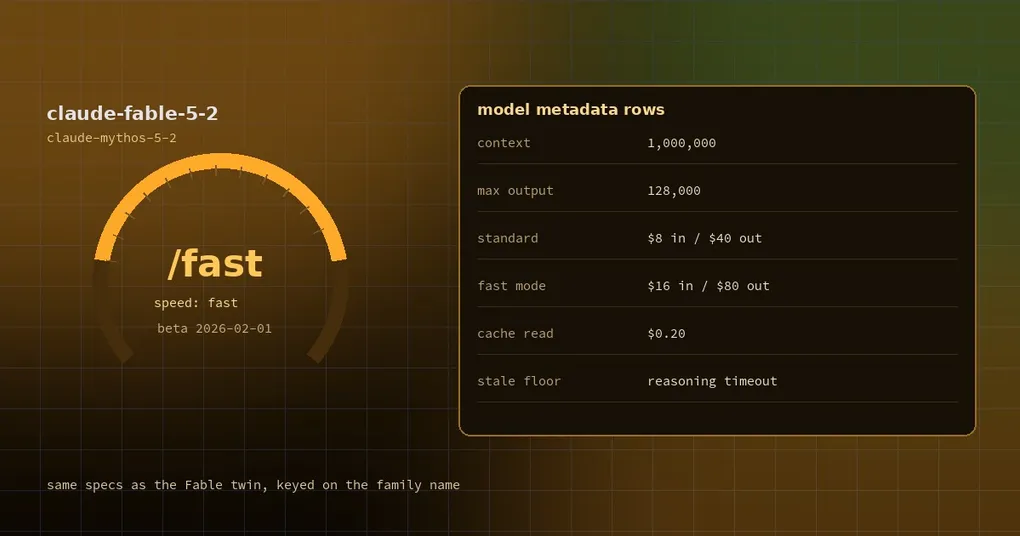
Claude Fable 5.2 lands in Hermes with PR #152220, merged on 2026-11-09 at 21:33 UTC. Roughly six hours later, PR #152393 merges with three changes for Claude Mythos 5.2: fast mode switched on, the 1M-token context window it should always have had, and the reasoning stale-timeout floor that Fable already carried.
Fable 5.2 is the publicly available model. Mythos 5.2 is the sibling with the identical spec sheet — 1,000,000 tokens of context, up to 128K of output — restricted to members of Anthropic’s Cyber and Life Sciences Verification programs. If the second PR reads like housekeeping next to a model launch, start with the 200K section: that housekeeping was quietly costing Mythos users real context.
Fast mode, without the jargon
A fast-mode request is the same model at a different service level. You send speed: "fast" next to the normal request body, and the Claude API returns tokens sooner. The PR also carries the fast-mode-2026-02-01 beta header, while Anthropic’s platform documentation lists the parameter as generally available. Nothing about the weights, the context window or the prompt cache changes. What changes is the price per token, which doubles.
Two terms are worth pinning down before the tables:
- Context window — the total amount of text (system prompt, files, tool output, conversation history) the model can hold in a single request. Exceed it and the request is rejected or Hermes has to compact history, so the number matters more than any benchmark score.
- Cache read — the discounted rate you pay for input the API has already seen, typically the stable prefix of a prompt you resend. A cache write is the surcharge for placing that prefix in the cache, and the five-minute variant expires quickly.
Both reappear in the fast-mode price list, which surprises people: you do not keep the cheap cache rate while paying the fast rate for output. Everything scales by the same factor.
Model identifiers, and who can actually reach them
Names are where these two models get confusing, because three systems spell them three different ways.
| Where you run it | Fable 5.2 | Mythos 5.2 |
|---|---|---|
| Native Anthropic API | claude-fable-5-2 |
claude-mythos-5-2 |
| Bedrock | anthropic.claude-fable-5-2 |
— |
| OpenRouter | anthropic/claude-fable-5.2 |
— |
| Nous Portal | anthropic/claude-fable-5.2 |
not listed |
The slash-and-dot form is the OpenRouter and Nous Portal convention; the dashed form is what the native Anthropic API accepts. Bedrock bills anthropic.claude-fable-5-2 at the same standard rates as the direct API.
Mythos 5.2 is the interesting column. Access is limited to Anthropic’s Cyber and Life Sciences Verification program members, and at the time the second PR merged, Nous Portal answered 404 for both anthropic/claude-mythos-5.2 and anthropic/claude-mythos-5-2, and the id was absent from the Portal’s model list — 396 ids at that moment. Put plainly: if you reach Claude through Nous Portal, the fast-mode half of this release does not apply to you yet. If you use the native Anthropic API, it does, and /fast is the switch.
The 200K hole
The context regression was not a bug in the API client. It was a missing key in a dictionary.
Hermes keeps a table of default context lengths, used whenever a provider does not hand back a live number — a cold metadata cache, a proxying endpoint, a provider that simply does not report the value. The relevant rows look like this:
DEFAULT_CONTEXT_LENGTHS = {
    # ...
    "claude-fable-5": 1000000,
    "claude-fable": 1000000,
    "claude-mythos": 1000000,
    "claude-opus-5": 1000000,
    "claude-sonnet-5": 1000000,
}
Now look at what is not there: claude-mythos-5-2. The table keys the Fable family on the claude-fable prefix, so claude-fable-5-2 resolves and keeps its million tokens. Mythos shares the specification — 1M context, 128K output — but not the prefix, so claude-mythos-5-2 fell through to the generic claude entry at 200,000 tokens.
| Model id | Context used without a live lookup, before | After |
|---|---|---|
claude-fable-5-2 |
1,000,000 | 1,000,000 |
claude-mythos-5-2 |
200,000 (generic claude fallback) |
1,000,000 |
The failure mode is nasty because it is quiet. When the provider returns metadata, nothing goes wrong — the real limit arrives with the response. On the paths that rely on the fallback, though, Mythos behaves like a 200K model, and a long session running past 200K gets compacted far earlier than it should. No error appears; history is just summarized sooner than necessary, which reads like the model got dumber overnight.
PR #152393 adds the Mythos entry to that table. The second half of the fix is subtler.
The reasoning stale-timeout floor
When a reasoning model thinks before answering, something has to decide how long silence is acceptable. If no token arrives within the stale window, Hermes treats the request as hung and retries, and the attempt is thrown away.
Long chains of thought are exactly the case that trips this. Fable had a floor applied to that reasoning budget — a minimum amount of thinking time a model is granted before its request can be called stale. Mythos had no such floor, so on a genuinely hard prompt it could be cut off before its first token ever landed: no answer, no output to bill against, and a retry that starts from scratch. The same PR gives Mythos the floor, matching Fable.
That is the whole release in one sentence: one model added, one model made equal to its twin.
What fast mode costs
Only Fable 5.2 has published line items in the pricing table, and they are worth reading as a pair, because the fast-mode row is nobody’s discount.
| Per million tokens (USD) | Input | Output | Cache read | 5-minute cache write |
|---|---|---|---|---|
| Fable 5.2, standard | $8.00 | $40.00 | $0.20 | $10.00 |
| Fable 5.2, fast mode | $16.00 | $80.00 | $0.40 | $20.00 |
| Fable 5.2 on Bedrock | $8.00 | $40.00 | $0.20 | $10.00 |
Do the arithmetic before flipping the switch: fast mode pays for itself when wall-clock latency is the bottleneck — an interactive coding loop, an agent waiting on tool round-trips. It is a poor trade for batch work, for long-context jobs dominated by re-sent cache reads, or for anything you will run ten times to get right. Doubling a $0.20 cache read is pocket change; doubling $80 of output is a line item someone will ask about. If you reach Claude through a subscription rather than an API key, the provider guide covers which path bills against which quota, and this breakdown of Claude subscription metering explains why identical work can move your utilization by very different amounts.
Turning it on
/fast is an existing slash command — hermes_cli/cli_info_mixin.py handles it — so there is nothing new to install. What these two PRs changed is the list that switch consults, and the list the native Anthropic request gate consults:
_ANTHROPIC_FAST_MODE_MODELS = frozenset({
    "claude-opus-4-8",
    "claude-opus-5",
    "claude-opus-5-5",
    "claude-fable-5-2",
    "claude-mythos-5-2",
})
A model qualifies if its id lands in that set after normalization. The check accepts a vendor prefix (anthropic. or anthropic/), dotted spellings such as claude-mythos-5.2, and an 8-digit date suffix like -20260601, which is stripped before the comparison — so claude-fable-5-2, anthropic/claude-fable-5.2 and anthropic.claude-mythos-5-2-20260601 all resolve to an entry. A separate model id that merely ends in -fast is a different thing and is not in this set.
One clarification, because the naming invites the mistake: fast mode is a request parameter on the same model id, not a second model. There is no separate Fable-fast deployment or endpoint to configure.
What this changes for you
- Native Anthropic, Fable 5.2. Everything works today.
/fastengages; budget double per token, including cache reads and writes. - Native Anthropic, Mythos 5.2. Requires Cyber or Life Sciences Verification membership. Once you have it,
/fastapplies, and your context window no longer collapses to 200K when metadata is unavailable. - Nous Portal or OpenRouter. Fable 5.2 is available under the dotted id at standard pricing. Mythos 5.2 is not listed, so the fast-mode and context changes in the second PR are academic for you.
- Anyone running long sessions on Mythos. The stale-timeout floor is the fix you did not know you needed — long reasoning turns stop dying before the first token.
If you are new to the CLI side of this, the command reference covers the other slash commands you will type inside a session, and the plugin catalog guide is where to look if you want to automate any of this rather than type it per session.
The pattern across both PRs is the same one that shows up every time a model family grows: the model itself is one pull request, and making it behave like its siblings is another. Watch the second one. A wrong context window and a missing stale floor do not announce themselves; they just make a good model look mediocre.