Nous Research raised $90M — and Hermes is going after businesses. Here is what changes for you.
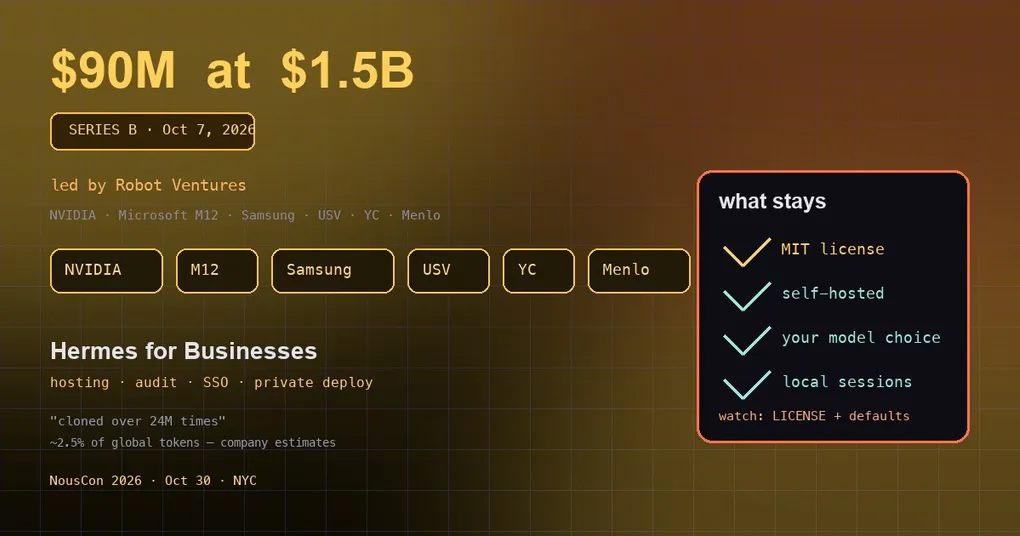
Every time someone asks whether Hermes will end up behind a subscription, the answer is roughly the same: the license says MIT and the code runs on your machine. Then a funding headline lands and the question comes back anyway. On October 7, 2026, Nous Research published “A Note on Our Fundraise”: $90 million raised, a $1.5 billion valuation, and a new name for where the company goes next — Hermes for Businesses.
None of that is bad news for users, but it is worth reading carefully. Money arrived, the direction shifted, so what actually moves? Here are the facts from the announcement, the numbers that belong to the company rather than to an independent measurement, and the parts that touch your setup.
The facts: the round, the valuation, the investors
The Wall Street Journal reported it first, and Nous Research then published a signed note — nousresearch.com/a-note-on-our-fundraise, written by CEO Dillon Rolnick — confirming:
- $90 million raised at a $1.5 billion valuation, as a Series B;
- led by Robot Ventures;
- with NVIDIA, Microsoft’s M12, Samsung, Union Square Ventures, Y Combinator, and Menlo Ventures among the investors named in the note.
The story has a paper trail. Back on July 13, TechCrunch reported Nous was in talks to raise at least $75 million at the same $1.5 billion valuation, led by Robot Ventures; the company declined to comment at the time, and we covered that rumour-stage version in July. Three months later the figure settled at an official $90 million, and the interesting part moved from “how much” to “spent on what”.
Which numbers are the company’s own estimates
Two figures in the note are striking, and they are not the same kind of fact as the round size:
| Number | What the note says | Status |
|---|---|---|
| Hermes cloned over 24 million times | “cloned over 24 million times” | Company-reported; not independently verifiable (GitHub does not publish clone counts) |
| Roughly 2.5% of all global token usage | “to our best internal estimates” | The company’s own internal estimate — the note hedges it in the same sentence |
Neither is a fabrication; both are self-reported scale claims that must be attributed. Read them the way the note presents them — as Nous arguing it is “by many metrics the most widely used open source AI agent in the world” — and notice what backs the argument: usage, not revenue. Which is a fair part of why an enterprise product is the next step.
What “Hermes for Businesses” is — and is not
The enterprise paragraph is deliberately abstract. Broken into pieces, it promises four things:
- Model and price choice stays yours: it “will cut your spend by letting you choose the best models at the best prices for your goals, and it will give you the heuristics to make those decisions”;
- safe, private scale: in the note’s words, “let your AI use scale safely and privately”;
- bottom-up intelligence: building a corpus “by enabling the talent you have”;
- ownership of institutional knowledge: “dominion over your institutional knowledge”.
What it is not is the classic “crippled open core, complete paid tier” play — at least not on paper. The note restates the founding principle explicitly: the people using an AI system should control it, and Hermes Business extends that to companies, “and we’re doing it in the open.”
The thing to actually watch is where the paid boundary lands. Today, Nous Portal already runs tiered subscriptions (a free tier, model access and search quota by tier), while local runs and bring-your-own-API-key have stayed untouched. Enterprise money most plausibly lands on what open source never provided anyway — hosting, compliance, audit, SSO, private-deployment support. That distinction is what decides whether the copy of Hermes on your machine gets thinner.
Two things matter more than the valuation
The license. One line in the note deserves to be pulled out: Hermes Agent shipped under MIT “this past February, because we believe tomorrow’s moats will be built around execution, trust, and extensibility.” A $90 million raise makes that sentence more expensive to keep — the classic route for a company that later wants to monetize the core is relicensing, and the past few years offered several examples. So the file to watch for open-source users is not the pitch deck, it is the LICENSE file and the release pages.
Telemetry defaults. Enterprise sales bring compliance pressure, and compliance pressure often arrives as “telemetry on by default”. Hermes is currently restrained here — we recently went through exactly what gets sent, and it is itemized, opt-in, and separable. Whether those defaults loosen for enterprise needs is something every self-hoster should re-check periodically.
Four signals worth tracking
If you run Hermes on anything long-lived:
- LICENSE and CONTRIBUTING changes. Anything about licensing, contributor agreements, or trademark terms matters to you more than the round size.
- Where enterprise features land. Hosting, audit, SSO, private-deployment support: in the open repository, or only in a commercial product?
- Telemetry and data defaults. Are new collection points on by default, and do they apply only to Portal users?
- Catalog review rigour. Nous says the team reviews every community plugin. With the catalog already past a hundred entries, whether review tightens or loosens decides the risk of installing third-party plugins.
One date to note: the official announcements list NousCon 2026 on October 30 in New York, which is roughly when enterprise specifics should get less abstract.
What it changes for you today: essentially nothing
Back to daily use. This round does not put a paywall in front of you tomorrow. Nothing you can currently do has changed:
- the code is still MIT, your self-hosted install and your own API keys keep working;
- model choice still lives in
config.yamland/model, independent of whether you use Nous Portal; - session data is local and exportable — session backup and export covers it in detail;
- if you want zero third-party services, the search backend, telemetry, and memory provider can each be switched off.
The genuinely useful move is lowering your switching cost: keep provider configuration in your own config.yaml instead of hard-wiring critical flows to one hosted service, export sessions and skills on a schedule, and try changing model provider once on a small project. None of that depends on who raised what — it just means your workflow stays yours regardless of which round closes next.
For background on this site’s relationship to the project, see the about page — this is an independent community site. The current release is on the release notes.
The short version
$90 million, a $1.5 billion valuation, led by Robot Ventures with NVIDIA and Microsoft’s M12 in the round — those are the hard facts. “24 million clones” and “2.5% of global token usage” are the company’s own estimates and should be quoted as such. The enterprise direction is called Hermes for Businesses, and the stated principle is still open development and user control.
Put plainly: funding changes who the company wants to serve, not automatically what the code does. But licensing and default settings are the two switches to keep an eye on, starting now.