v0.22.4 touched six things — and finally removed those suggestion pills above the composer
You open the desktop app to change one line, and there is a row of little pills above the composer: set up MCP servers, maybe try this feature. You never asked for them, and there is no switch to turn them off. Tolerable the first time you see it in a day. By the tenth time you want to throw the keyboard.
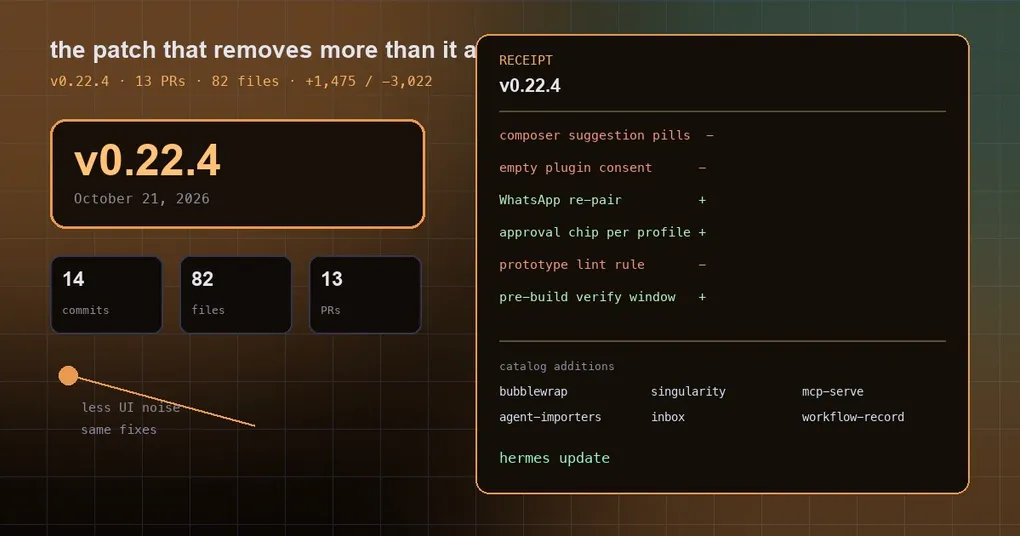
v0.22.4, published on October 21, 2026, removes the whole thing — not with a setting, but by deleting the pills and the helper code that existed only to feed them. It is a small patch: from v0.22.3 to here there are 14 non-merge commits across 82 changed files (+1,475 / −3,022) and 13 merged PRs. It removes more than it adds, and that is the interesting part: deleting the right things is a quality signal, not a missing feature list.
Six changes, one line each
| Change | In plain words |
|---|---|
| Suggestion pills above the composer are gone | The annoyance from the opening paragraph, plus the helpers only they used (#142559) |
| Plugins that install nothing skip the consent step | No more empty dependency prompt for a plugin whose pyproject.toml installs nothing (#142569) |
| WhatsApp can be re-paired safely after logout | Logging out in the dashboard no longer leaves the pairing in a broken state (#142439) |
| Desktop plugin review relaxes one lint rule | The surface lint stops flagging prototype writes; reviewers check those by hand (#142586) |
| The approval-mode chip follows the active profile | Multi-profile users stop seeing a chip that names a mode the profile is not running (#142565) |
| Release builds get more time to pre-check | On slow storage the desktop bundle’s pre-build verification can finish instead of failing (#142623) |
Two of these deserve more than a table row, because both look like cosmetic UI bugs while actually making you reason from wrong assumptions.
An empty prompt teaches you to click through prompts
Since plugins grew into portable packages, installation inserted a dependency-consent step: here is what this plugin will add to your Python environment. The problem is that a large share of plugins add nothing at all — a tool, a slash command, no packages. They still showed a consent dialog with an empty list.
The real damage is not the extra click. It is that an empty dialog trains you to approve without reading. The one time the dependency list matters, you will click through on reflex. After v0.22.4, no dependencies means no step.
The approval chip stops lying
If you run several profiles — a default one, a locked-down review one — the approval-mode chip in the desktop header could previously show a mode that was not the active profile’s. It reads like a display bug. The consequence is worse: you issue instructions on a false assumption. You believe the session is in smart mode and that a destructive command will pause for review, while it is running in manual, or in a mode someone loosened earlier.
The chip now reads the active profile’s own mode. Practical advice: after upgrading, switch profiles once and watch the chip follow. That check costs five seconds; reconstructing what mode you were in after a bad command costs an afternoon.
The plugin catalog grew by six entries
Half of the commits in v0.22.4 are catalog entries, and for anyone who uses plugins this is the more valuable half:
- bubblewrap — a bwrap terminal backend on Linux. Filesystem isolation for commands without root and without a full container runtime.
- Singularity / Apptainer — the container runtime most HPC and cluster environments standardize on, moved out of core into an official plugin.
- mcp-serve — lets Hermes be an MCP server. It used to be built in as
hermes mcp serve; now you install it withhermes plugins install mcp-serve, and client configs changeargsfrom["mcp", "serve"]to["mcp-serve"]. Tool names and parameters are unchanged, and the old spelling does not fail silently — it prints the new form and the install line. - agent-importers —
hermes import-agentlikewise leaves core, and this release adds Cursor to the list of agents you can migrate from. - inbox and workflow-record — two community entries from Hermes Labs.
- Telegram Business moves from the official shelf to the Hermes Labs community tier.
Run hermes plugins update after upgrading to pick these up. The full flow is in our bulk plugin update guide.
v0.22.3, six hours earlier, was the big one
Easy to miss: v0.22.3 shipped the same day, and it is the rollup that turned everything merged since v0.22.2 into a stable release — 2,911 non-merge commits across 4,206 files (+360,278 / −64,308), about 620 merged PRs and 326 closed issues. The official notes say the curated release notes for that window ship with v0.23.0; v0.22.3 exists so the CLI, installer, Microsoft Store app, Docker and Hermes Cloud all carry the same code.
So if you are a CLI user who runs hermes update whenever there is something new, October 21 actually moved you across two releases. Both have pages here: v0.22.3 and v0.22.4.
Upgrading
# CLI installs
hermes update

# or re-run the installer
curl -fsSL https://hermes-agent.nousresearch.com/install.sh | bash- Microsoft Store app: updates through the Store.
- Desktop app from the installer (.exe / .dmg): no desktop bundle change in this release; it moves with the next bundled release.
- Docker / Hermes Cloud: pull
nousresearch/hermes-agent:stable(or:latest).
To confirm where you landed, check the version badge on the site or run hermes version. If you hit gateway-restart or long local-turn timeouts recently, the v0.22.2 patch notes cover the fixes that actually mattered in this line.
Why a patch like this is worth a page
A patch that removes 3,022 lines, adds 1,475, and ships no new capability rarely deserves its own article. Two signals make it worth writing down anyway. First, the team chose to delete noise instead of shipping another toggle. Second, the migration of built-in features into the plugin catalog is still moving — mcp serve, import-agent and the terminal backends all took that path in this release.
The practical consequence for you: after upgrading, run hermes plugins update once, or you will conclude a command disappeared. Our plugin catalog walkthrough helps decide which entries are worth installing.