GPT-6.2 Astra and Sol land in Hermes: a 1.05M window, four times the price
It is Friday evening and you want the agent to read an entire repository and explain how one module actually works. The first twenty minutes go fine. At minute twenty-one it starts repeating itself: the context is full. So you open the model picker and find two new names — gpt-6.2-astra and gpt-6.2-sol. Which one? And is the expensive one really worth four times the money?
PR #157141, merged on November 18, wired both models into Hermes on the direct OpenAI API and on Codex, along with their windows, reasoning ladder, fast tiers and pricing. What follows sticks to what the code and the official docs actually say.
Two models, two routes
Selection is unchanged: pick OpenAI API (API key) or OpenAI Codex (ChatGPT subscription) in hermes model, then choose gpt-6.2-astra or gpt-6.2-sol. Existing explicit model choices are not rewritten.
The two routes are not the same product:
- Direct API: you pay per token, and the window is the documented 1,050,000 tokens.
- Codex: the account’s own catalog decides, usage stays inside the subscription, and no API invoice appears.
One default changed with this patch: on the direct API, an install with no model configured now defaults to gpt-6.2-sol. On Codex, Hermes prefers the account catalog and falls back to gpt-6-sol when it cannot read one.
Windows and prices
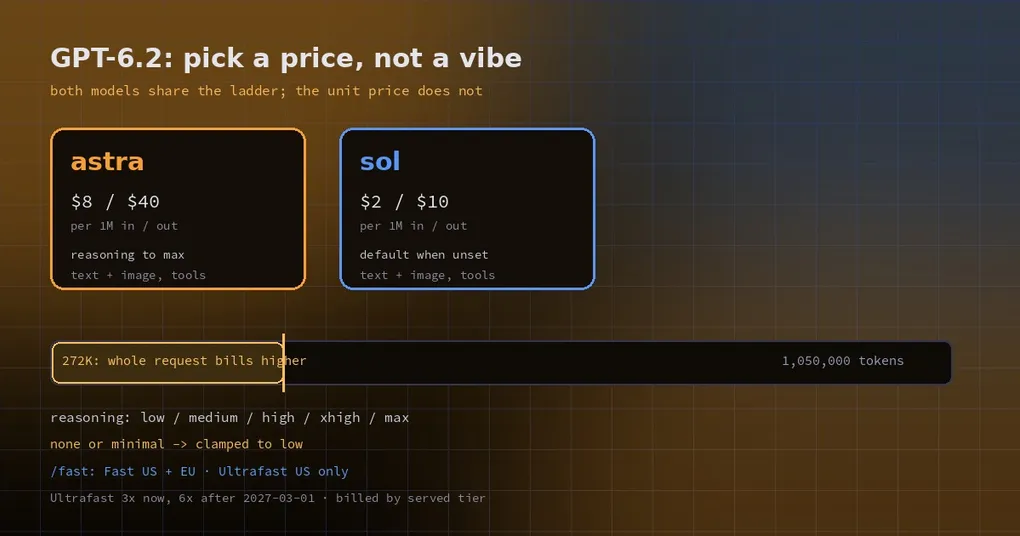
Both models accept text and images, call tools over the Responses API, and offer reasoning from low through max. They differ on price:
| Model | Direct window | Input per 1M | Output per 1M | Cache read | Cache write |
|---|---|---|---|---|---|
gpt-6.2-astra |
1,050,000 | $8.00 | $40.00 | $0.40 | $10.00 |
gpt-6.2-sol |
1,050,000 | $2.00 | $10.00 | $0.10 | $2.50 |
The direct API caps input at 922,000 tokens and output at 128,000 tokens per request.
There is a tier cliff that is easy to miss: once a request crosses 272,000 tokens, the whole request bills at higher rates — input ×2, output ×1.5, cache read and write ×2. A “read the whole repo” task is therefore not linear in cost: two 150K requests are usually cheaper than one 300K request. Cache hits narrow the gap substantially, which is why the second run of the same long job is often much cheaper than the first.
Codex does not use that table at all. It uses the account catalog’s window, with offline defaults of 272,000 for Astra and 500,000 for Sol. Hermes deliberately does not invent -900k or -pro picker variants for either model.
The reasoning ladder
Both models accept low, medium, high, xhigh and max. Hermes handles three edge cases itself:
- An explicit
noneorminimalis clamped tolowinstead of being sent as a value the model rejects. - When reasoning is actually disabled, Hermes omits the unsupported disable field rather than sending an illegal one.
- Before this patch, manually selecting these models clamped
maxdown toxhigh. That is fixed.
For cost-sensitive long jobs, high is usually the better deal: max spends noticeably more reasoning tokens, and most engineering tasks do not need them. For a one-off large refactor or a genuinely nasty bug, max earns its cost.
/fast: Fast reaches the EU, Ultrafast does not
/fast is a per-session speed switch: /fast normal|fast|ultrafast|auto|cold, with /fast ultra as shorthand for ultrafast. Both new models support the Fast tier, but the geography differs:
- Fast: US and EU processing.
- Ultrafast: US processing only, and on Codex it stays gated on what your account offers.
Pricing follows the served tier. Ultrafast currently runs at 3× standard as a launch discount through February 28, 2027 Pacific time, then moves to 6×; the priority tier is 2×. Crucially, a request that asks for Ultrafast but is served at standard speed is billed at standard rates — you do not pay triple for a fast tier you did not get.
That matters for budgets: /fast auto does not mean “always fast”, it means “allowed to be fast when the server can”. If you are controlling spend on long-context work, set /fast normal rather than leaving acceleration on.
When not to pick them
- Your ChatGPT plan does not include GPT-6.2. The picker shows the models, but requests will not work. The documented fallback is
gpt-6-sol. - Your Codex app-server binary is old. It will reject the new models. Either update the binary Hermes launches (the docs cite 0.169.1, including an explicit
model.codex_binpath), or use/codex-runtime autoand start a fresh session so Hermes uses its native route. Neither changes what your plan allows. - Your tasks fit comfortably in 100K tokens. Astra’s four-times price does not buy four times the output there. Run Sol for a week, notice which specific tasks fall short, and route only those to Astra. Per-task routing beats a global switch.
Can you use them today?
These models merged to main on November 18. v0.23.2 shipped on November 16, so no current release contains them; the next one will. Tracking main works if you accept trunk instability.
For background, read the GPT-6 Astra field notes, or the model overrides guide if you want different models per task. Command details live in the hermes model reference, and the rest of the release is summarised in the v0.23.2 roundup.
Update (2026-11-20): these changes shipped in v0.23.3 (November 20) —
hermes updatebrings them in. The “onmainonly / no release contains it yet” wording above reflects publication day.