Gemini 4 in Hermes: four models, and xhigh works on exactly two of them
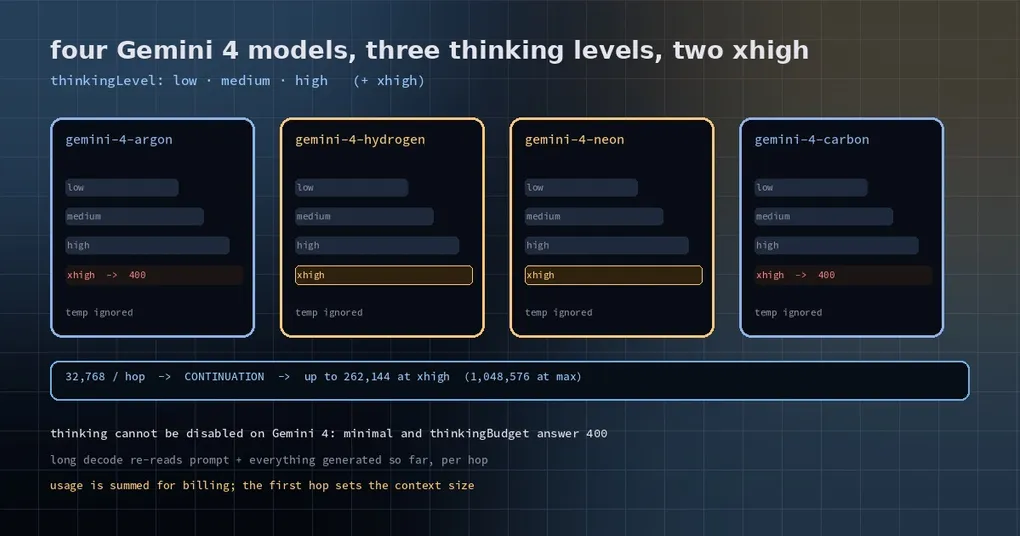
You switch the model to gemini-4-hydrogen, push the reasoning effort to xhigh, and get a 400. You drop back to high and everything works. You try gemini-4-argon to reproduce the error — also a 400 on xhigh, and high is fine again. So you conclude Gemini 4 does not support xhigh.
It does. Just not on those two models.
Details like this never make it into a “Gemini 4 supported” announcement, but they decide whether your config works on the model you picked. Here is what Gemini 4 actually does inside Hermes after v0.23.4.
Four models, two of which take xhigh
Before v0.23.4 there was exactly one Gemini 4 choice in Hermes: gemini-4-argon. This window adds the other three and lists them on Nous Portal, OpenRouter and Vertex:
| Model | Standard thinking levels | xhigh |
|---|---|---|
gemini-4-argon |
low / medium / high |
Not supported, 400 |
gemini-4-hydrogen |
low / medium / high |
Supported |
gemini-4-neon |
low / medium / high |
Supported |
gemini-4-carbon |
low / medium / high |
Not supported, 400 |
The rule is hardcoded in agent/reasoning_effort.py: thinkingLevel is lifted to xhigh only when the model id starts with gemini-4-hydrogen or gemini-4-neon and the requested effort sits above high. On the other Gemini 4 models the mapping stops at high no matter whether you write xhigh, max or ultra, so the request that would earn a 400 is never sent.
One easy trap: on aggregator providers the model id usually carries a prefix, like google/gemini-4-hydrogen. Hermes strips google/ and gemini/ before applying those rules, so the config works with or without the prefix.
Thinking cannot be turned off
There is no “disable thinking” on Gemini 4. Asking for the minimal level, or sending an explicit thinkingBudget, both answer 400. Hermes therefore changes strategy: a thinking-off request on these models is sent at the lowest level, low.
That is fine for most work, but it has two consequences:
- side tasks (title generation, auxiliary calls) normally save time by turning thinking off; on these models they cannot, they can only drop to
low; - if your routing is “cheap model for chores, expensive model for the main conversation”, pointing the chores at Gemini 4 is a bad deal.
Long decode: one answer, several requests
A single Gemini 4 request is capped: 32,768 tokens unary, 65,536 streamed. But maxOutputTokens can reach 1,048,576 minus the input, and the gap is closed by long decode. When a hop hits the per-request cap with budget left, the response ends with finishReason: CONTINUATION and a continuationToken. The client resends the same request with that token — not the partial output appended — until the finish reason is something else.
That affects both billing and context, and Hermes handles it carefully:
- Usage is summed per hop. Every hop re-reads the prompt plus everything generated so far, so prompt tokens grow hop by hop. Billing uses the sum, which is what Google bills.
- Context size comes from the first hop only. Treating the summed prompt as the context length would make compaction fire many turns too early. This is the easiest thing to get wrong in a long-decode implementation.
- The budget depends on effort.
xhighgets 262,144 tokens;maxandultraget 1,048,576. Every other level gets no extra budget and stays at the per-request cap. - Hop count scales the stale watchdog. A non-streaming request runs under one timer that spans every unary hop, so the stall budget is multiplied by the hop count. Otherwise a healthy multi-hop answer gets killed on hop two and re-billed from hop one.
- A dropped stream resumes from its checkpoint. It continues from the last checkpoint token instead of restarting, which matches how Google bills a dropped stream: up to that checkpoint.
If your answers regularly approach the per-request cap — a long document, a large block of code — this machinery is the difference between getting the whole thing in one turn and getting a truncated one. In ordinary chat it rarely engages.
Also: temperature is ignored
Since Gemini 3.6 (Gemini 4 included), temperature, top_p and top_k are not honoured. Any config where you lowered temperature to make output “more stable” is a no-op on Gemini 4.
The levers that remain are the prompt, tool constraints and the thinking level — which is exactly why a wrong level feels like “this model is inconsistent today”.
One more detail: some Gemini 4 models are served only in the global location. The adapter builds the projects/{project}/locations/{location} path correctly, so you do not have to rewrite an endpoint yourself.
How to configure it
Pick the model:
hermes model # interactive provider and default-model pickerSet the global effort:
hermes config set agent.reasoning_effort highValid levels are none, minimal, low, medium, high, xhigh, max and ultra; on Gemini 4, none and minimal both land on low.
A practical set of choices:
- Everyday coding and config work:
high. Gemini 4’shighis already heavy; going up buys little and costs latency. - Let it think before it acts (architecture, multi-file refactors, long documents):
xhighon Hydrogen or Neon, the only models wherexhighis real. - One very long output:
maxorultrawith long decode. Remember it is a total budget: time and cost scale with it. - Side tasks: do not point them at Gemini 4. Thinking cannot be turned off, so title generation is pure waste there.
The short version
The three Gemini 4 traps in Hermes are not about support, they are about which combinations are valid: xhigh only on Hydrogen and Neon, thinking that cannot be disabled (the floor is low), and per-request caps of 32,768 / 65,536 with a long-decode path that bills by the hop. Remember those and the rest is picking a model.
For the other terminal changes in the same release, see the three new commands in v0.23.4; if you write plugins and care about which prompt a session is waiting on, see the prompt hooks post. General routing lives in the config reference.