The model that could see never got the picture
Last Friday you dropped a screenshot of a stack trace into Telegram and asked Hermes what broke. The answer described the screenshot: “a terminal window with several lines of text, some of them in red.” No line number. No exception name. No file path. You blamed the model, switched to a bigger one, asked again — same answer.
The model was fine. The image never reached it.
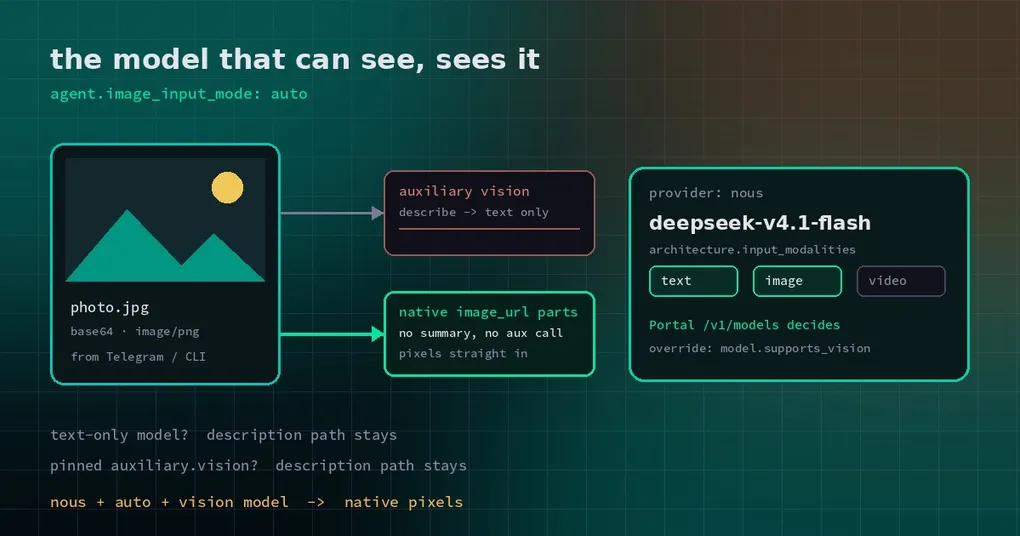
To handle an image at all, Hermes has to know whether the model in front of it can see. If it can, the image goes into the request as pixels. If it cannot, an auxiliary vision model writes a description first and that paragraph goes in instead. That is a sensible design, but for models served through Nous Portal the lookup always came back empty: the catalog Hermes consults, models.dev, has no nous provider entry. “Unknown” is treated as “cannot see”, so every image took the long way around.
A report from Discord shows the cost precisely: a session running deepseek/deepseek-v4.1-flash-1017 through Nous sent twelve photos in a row to stepfun/step-3.7-flash:free for description. Both of those models can see. The pair of eyes in the room was being bypassed by a narrator.
What the decision actually consults
The change that merged into main is small: one more probe in the list that answers “can this model see?”, reading architecture.input_modalities from the Portal’s own /v1/models response.
The order is now:
model.supports_visionif you set it — your word beats every probe;- the managed local runtime’s capability table;
- the models.dev catalog;
- the Nous Portal catalog (new);
- the Ollama probe.
The first probe with a definite answer wins; “unknown” passes to the next one. Which means this fix only matters where every other source was silent and you happen to be on Nous — exactly the hole that was there before.
One detail worth knowing: the probe returns a verdict only when the endpoint you are actually using matches the Portal address stored with your credentials. Point model.base_url at a relay of your own and Hermes will not borrow Portal’s catalog to guess about it.
Three settings, three outcomes
| Your setting | Portal says the model is | What happens to the image |
|---|---|---|
auto (default) |
text + image | pixels go in natively |
auto |
text only | an auxiliary model describes it |
auto, with auxiliary.vision pinned |
text + image | still described — your config wins |
native |
text only | pixels forced in anyway |
text |
text + image | always described |
One key controls all of it:
# ~/.hermes/config.yaml
agent:
  image_input_mode: auto    # auto | native | text
auto is the default and the one you want. The practical gain is that you no longer need to hand-write model.supports_vision: true to get pixels through — custom endpoints still need it, the Nous path no longer does.
How to check which path your setup takes
Start with the two keys that decide it:
hermes config get agent.image_input_mode
hermes config get model.supports_vision
If the first prints nothing set, you are on auto. If the second is explicitly false, it overrides every probe — which is by design, and also the most common reason someone cannot figure out why native images stopped working.
Then test with an image that carries detail and nothing else. A stack-trace screenshot plus “which line raised what” is a good probe: the native path names the line and the exception; the description path gives you “a screenshot of a terminal”. That test is faster than reading logs.
Native pixels are not free
Once an image is in the conversation natively, it is re-sent on every later request of that session. Ten screenshots in a long session means you are still paying for the first one at turn eleven.
Two keys bound it:
vision:
  embed_target_bytes: 262144   # per-image budget, default 256 KB, clamped 64 KiB..4 MiB
  max_calls_per_image: 3       # re-embeds per image; unset = 3 in subagents, unlimited for the main agent
This is also the second reason agent.image_input_mode: text exists. It does not only affect images you paste yourself: browser screenshots, computer_use captures and images returned by MCP tools follow the same switch. If you care more about cost than about detail, text is the cheapest setting available.
When you should turn native off on purpose
One case forces you back to the description path: a backend that accepts text but rejects native image input. Some openai-codex accounts answer an image request with server_error. You do not have to change your main model — move the aux vision backend:
auxiliary:
  vision:
    provider: openrouter
    model: qwen/qwen3-vl-235b
Leave auxiliary.vision.provider on auto and you get the same blind main model picked again, which changes nothing. Pin it explicitly and auto mode switches images to the description path; set agent.image_input_mode: text as well if you want that intent written down.
Not in a release yet
The change merged into main on 21 November 2026, a day after v0.23.3 shipped, so no tagged release contains it. Either wait for the next one or track main.
Update (2026-11-25): these changes shipped in v0.23.4 (November 24) —
hermes updatebrings them in. The “not in v0.23.3 / onmainonly” wording above is a snapshot from publication time.
Meanwhile the test above is worth running today: record what your current setup does, then run it again after the upgrade and compare. If model-level settings are the part you keep tripping over, we went through the override machinery in the model overrides guide; if you want the cost side of re-sent images, the context and token guide does that arithmetic. For exact key names, the hermes config reference is quicker than reading source.
The short version: whether a model can see is not something a third-party catalog should be answering for it. On the Nous path, the answer now comes from Portal itself.