Monitor Competitors on Autopilot with Hermes: Product Launches, Pricing, Funding — Nothing Slips Through
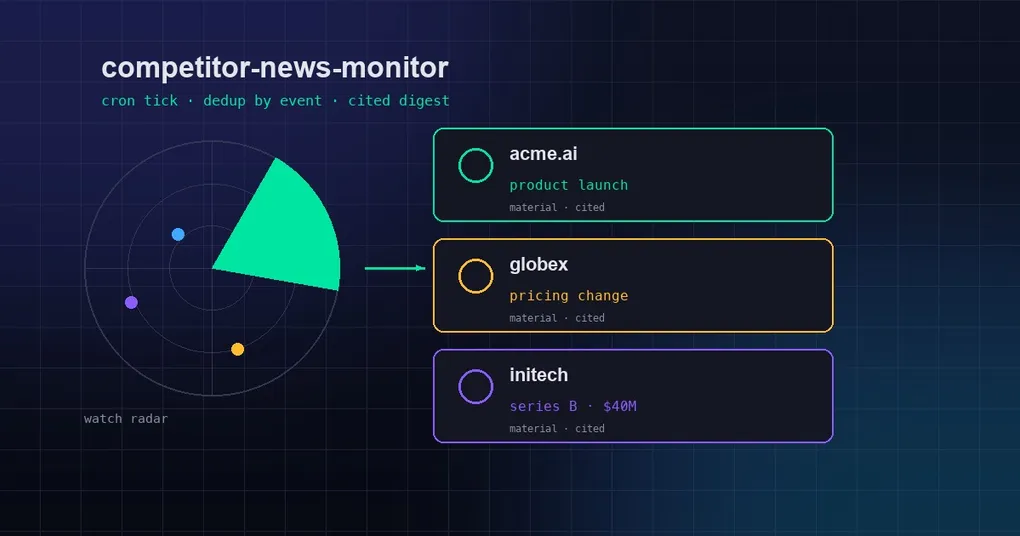
On Friday afternoon you open three competitor websites and check their news, pricing pages and funding announcements — a ritual you’ve repeated for six months. Last week you happened to be traveling, and a competitor quietly shipped a new plan; you only found out when a customer called asking “can you do that too?” Manual watching always has blind spots, and Hermes’ new built-in competitor-news-monitor skill turns that ritual into a monitoring machine that runs on a schedule: it watches events that matter, not just pages that changed.
Why competitor monitoring is hard
If you’ve tried monitoring competitors with a generic page-diff tool, you’ve hit three pain points:
- Too much noise: one funding round covered by ten outlets arrives as ten “news items”;
- The important stuff hides in the deep water: pricing changes and release notes usually live on a single page that broad news searches never surface;
- No sense of what matters: a job posting and a funding round have very different weight for you, but the tool doesn’t separate them.
That’s exactly the problem the competitor-news-monitor skill solves — merged into Hermes main on 2026-08-08 (PR #81945). It is not a simple “page changed” watcher but a complete competitor-intelligence pipeline: deduplicate by event, score by materiality, report only what has evidence.
What makes it different from a generic watcher
The skill’s own docs state the key point: “This is not a generic page-diff watcher.” What it actually does can be summarized in three layers:
- Source hierarchy: official newsroom/blog → pricing & product pages → regulatory filings & investor relations → status/security pages → reputable trade & financial press → job postings (weak signal only);
- Event-level dedup: one launch covered by ten outlets, in multiple URL variants, counts as one event;
- Materiality scoring: each event is scored on directness, source authority, novelty, customer/market impact and strategic relevance — with measured facts separated from interpretation.
In plain terms: a generic tool tells you “this page changed”; this skill tells you “this company shipped a product, here’s why it matters, and here are the evidence links.”
Setting it up: two phases
The skill splits the work into Setup (foreground, once) and Tick (each scheduled run).
Phase 1: freeze the watchlist
Write down what you care about for each company: canonical name, domains, products, aliases, geography/language, event categories (launches, pricing changes, funding, partnerships, executive moves, incidents…), cadence, audience and your materiality threshold.
The acceptance test: after writing it, grab a random candidate article and you can consistently say “this counts / this doesn’t.” Then the list is good.
Phase 2: build source coverage, then schedule
For each company, collect sources by priority:
- Official newsroom/blog and changelog;
- Pricing/product pages;
- Regulatory filings and investor relations;
- Status/security pages;
- Reputable trade and financial press;
- Job postings (weak supporting signal).
Technically: RSS/Atom feeds go through the built-in blogwatcher; pages and search go through web_search/web_extract. The watch contract — watchlist, categories, materiality threshold, last cutoff — is written to a state file at ~/.hermes/competitor-watches/<watch-slug>.json, and then you create the job:
hermes cron create \
  --name "weekly competitor watch" \
  --schedule "0 9 * * 1" \
  --prompt "Load the competitor-news-monitor skill and run the tick for this week's watch."
Don’t want to hand-write the prompt? Hermes’ automation blueprint catalog already includes a competitor-watch blueprint — pick it when creating the job and it will walk you through companies, categories, timing, recurrence and delivery target, then generate the scheduled job for you.
What happens on every run
When the schedule fires, the skill follows four steps:
- Collect incrementally: search from the last successful cutoff, with a small overlap to absorb late indexing. One important rule: a failed source means unknown coverage, never “no news” — record the gap honestly so nothing is missed next time;
- Deduplicate by underlying event: collapse syndicated stories, rewrites, URL variants, press-release coverage and revised filings into one event, keeping independently sourced corroboration attached;
- Assess materiality: score each event, attach “why it matters” and a confidence level;
- Deliver the update: company, event, date, evidence links, what changed, why it matters, confidence, follow-up watch. When there are no material events, stay silent (
[SILENT]) unless a periodic all-clear was requested.
Three pitfalls to avoid
The skill docs call out common failure modes — watch for them:
- Counting ten articles about one launch as ten developments;
- Monitoring only broad search and missing official pricing/changelog changes;
- Treating job postings as proof of a product decision — hiring patterns are a weak signal, never confirmed strategy.
Also: once the watchlist and materiality rules are frozen, don’t let them drift between runs. Same criteria every run is what makes results comparable.
When not to use it
This skill is for long-running, recurring, stable-criteria competitor monitoring. For a one-off “what’s new with company X”, just have Hermes run a web_search directly; for subscribing to a few blog feeds, blogwatcher is lighter. Don’t use a heavy weapon for a light task.
Combine it into a full intelligence pipeline
competitor-news-monitor is one member of Hermes’ bundled skill catalog. To make results not only land in your inbox but persist and notify, combine it with the automation stack: drive scheduling with cron jobs, keep state durable with cron monitor mode and notepad, and push digests to your messaging platform. Paired with the session-management tips, the whole intelligence flow can run unattended. If skills are new to you, the skill combos guide is a good place to start.
Bottom line: competitor monitoring was never hard because you weren’t diligent enough — it’s hard because of noise and unclear priorities. competitor-news-monitor bakes source hierarchy, event dedup and materiality scoring into a repeatable process; you just define the watchlist and the bar, then collect a clean digest every week.