One typo, one "successful" empty result: Hermes now refuses the wrong argument name
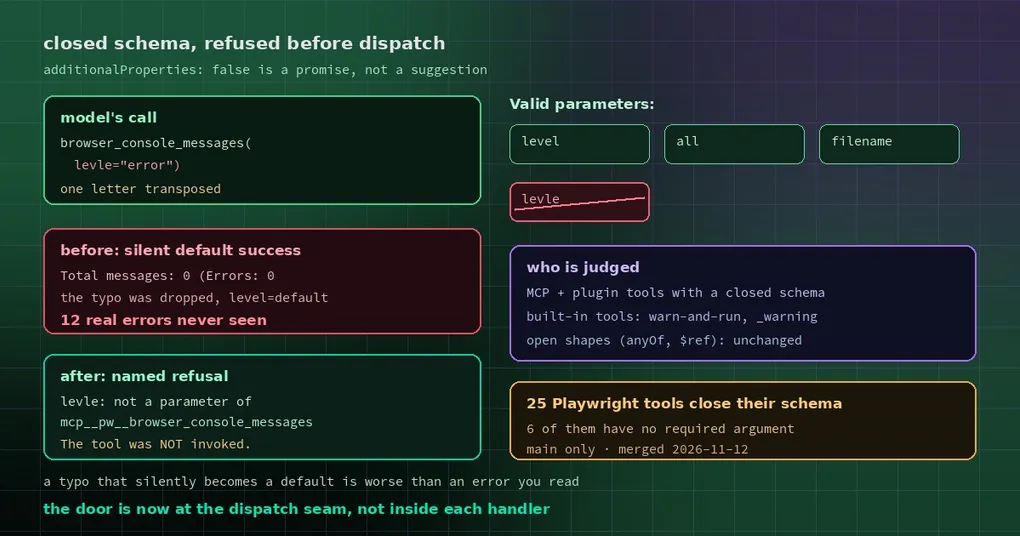
You ask the agent to check the browser console for errors. It calls Playwright’s browser tool with one letter wrong — levle instead of level. The tool does not complain. It returns a normal result: Total messages: 0 (Errors: 0, Warnings: 0). The agent reports a clean page.
The page had twelve errors. The argument was silently dropped, the tool ran on defaults, and everything looked fine. A silent success is far more dangerous than a failure — you read failures, you do not read successes.
PR #115682, merged on November 12, refuses calls like that before they run.
Why it succeeded silently
The answer is one field in the schema: additionalProperties: false.
MCP servers usually describe their parameters with zod or pydantic, and those libraries emit schemas that explicitly say “this object has exactly these keys”. That sounds strict, but the parse usually drops unknown keys instead of raising. So levle="error" is discarded as an extra key, level falls back to its default, the tool runs to completion, and a success comes back.
The model sees nothing wrong, so it keeps the wrong spelling for the rest of the session.
What happens now: refused before dispatch, with the valid names
The rule is short. If a third-party tool (MCP or plugin) closes its own schema, an undeclared top-level key is refused before the call runs.
Real @playwright/mcp over stdio, through the real MCP client and tool dispatch:
| Call | Before | After |
|---|---|---|
browser_console_messages(levle="error") |
Total messages: 0 ... — the typo silently dropped |
levle: not a parameter of mcp__pw__browser_console_messages. The tool was NOT invoked. Valid parameters: level, all, filename. |
browser_tabs(arguments={"action": "list"}) |
the server’s own zod error, about action, never naming the wrapper |
arguments: not a parameter of mcp__pw__browser_tabs. ... Do not wrap the arguments in an "arguments" field (that shape is only for tool_call); pass each one at the top level. |
browser_tabs(action="list") |
normal result | identical |
| Open-schema third-party tool with an extra key | handler receives the key | identical (unchanged) |
| Built-in tool with an unknown key | runs, result gains _warning |
identical (warn-and-run kept) |
Look at the second row. The wrapped-arguments mistake is one of the easiest for a model to make: it has seen tool_call’s arguments shape and assumes every call wants that wrapper. Before, you got a zod error from the server that mentioned only action, and you had to work out for yourself that the outer layer was the problem. Now the refusal says it.
Why built-in tools were left alone
Because a built-in tool’s schema is not the same kind of promise. Hermes writes those schemas itself and keeps a looser contract: an extra key does not fail the call, the result just gains a _warning telling you the name was not a parameter. The one built-in that does close its schema (manage_catalog) already refuses unknown keys in its own handler.
Put another way: the further outside the code, the stricter the door. A third-party tool’s properties list is a promise to its callers, so it is now enforced as one.
Where the check lives, and how far it reaches
It sits in _closed_schema_refusal in tools/arg_validation.py, as the first thing check_tool_args does — which means it covers every entry point that already runs argument checks: ToolRegistry.dispatch (MCP, plugin and registry tools on every surface) and the inline-executor wrapper.
One related fix in the same commit: a schema that closes the object but omits properties also refuses extras — “no arguments declared” is still “only these arguments”. Twenty-five Playwright MCP tools close their schema, and six of them have no required argument at all; those six are exactly where a typo used to turn into a silent default success.
Will your MCP servers be affected
The test is direct: look for additionalProperties: false in the tool’s schema.
- Modern MCP servers that generate schemas from zod or pydantic are closed, and will start refusing misspelled arguments.
- Hand-written JSON Schema, and open shapes (
anyOf,oneOf,$ref,patternProperties), behave as before — extras still reach the handler. - If one of your own plugins relied on “send an extra key and let the handler deal with it”, declare that key in
properties. That was always the clearer interface.
If your MCP setup is assembled from environment variables and files, it is worth re-reading how arguments get injected in MCP config context variables and how the boundary is drawn in the MCP catalog and its security model. An earlier post on local $ref schemas covered a different failure in the same area: arguments that could not be seen at all, rather than arguments seen wrongly and quietly accepted.
Release status
PR #115682 merged into main on November 12, 2026, with tests/tools/test_unknown_tool_arguments.py pinning two invariants: a closed schema refuses before the handler, and an open schema still admits extras. v0.23.1 shipped on November 10 and does not include it.
Update (2026-11-17): these changes shipped in v0.23.2 (November 16) —
hermes updatebrings them in. The “not in v0.23.1” wording above is a snapshot from publication time.
One footnote: if your tool list is enormous and the model keeps mixing up parameter names, the root cause may be schema size — slimming the tool schema is the other half of the same problem.