v0.23.5 ships 338 PRs and almost no release notes — on purpose
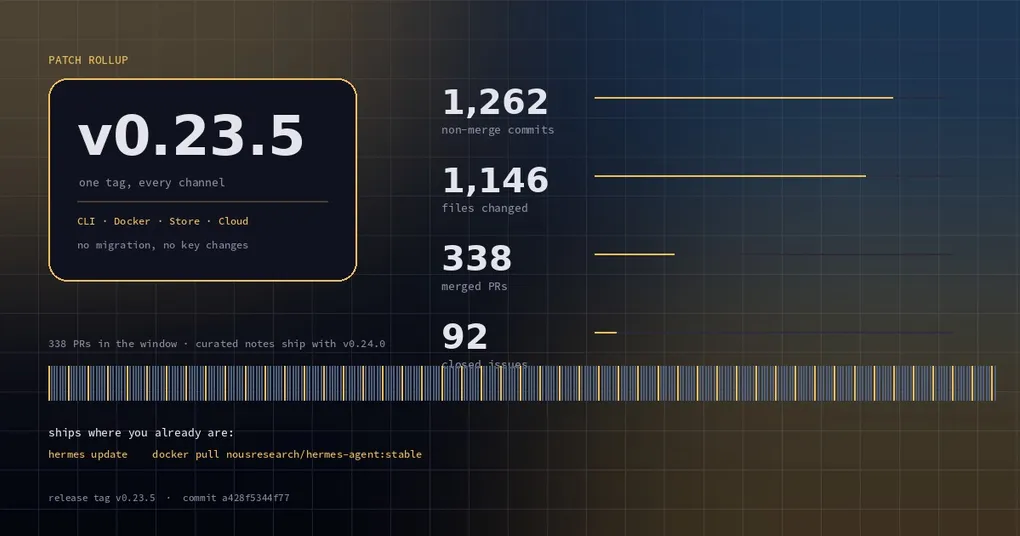
You run hermes update on a Saturday, and the CLI comes back with v0.23.5. You open the release page expecting the usual wall of highlights, then find three paragraphs, a builds table, and one sentence saying the curated notes ship with v0.24.0. No feature sections. No contributor credits. Just a tag.
That is not a release that forgot its homework. It is a patch tag doing exactly the job a patch tag is for — putting three hundred merged pull requests into a version that GitHub releases, the CLI installer, the Microsoft Store app, Docker and Hermes Cloud can all point at — while the long-form documentation waits for the next minor release. The interesting part is what is inside the window and how little of it the short body admits to.
A patch release that tells you what it counts
The numbers come straight from the release body, measured at commit a428f5344f77:
| Metric | Value |
|---|---|
| Non-merge commits since v0.23.4 | 1,262 |
| Files changed | 1,146 |
| Lines added / removed | +57,989 / −5,346 |
| Merged pull requests | 338 |
| Closed issues | 92 |
A patch release with more than a thousand commits is not a hotfix. It is a fortnight of work that has been landing on main continuously — the release body itself describes it as the rollup for everything merged since v0.23.4 — and the tag simply gives that stream a stable name. Docker users who pull nousresearch/hermes-agent:stable get the same code the CLI updater installs, which is the point: one tag, every distribution channel.
Three changes that actually change your day
1. A supporting terminal can now bring your session back. v0.23.5 adds OSC 7577 Program Resume: the CLI, the Ink TUI and gateway chat report a resume command to the terminal, authenticated with the terminal’s OSC7577_TOKEN, and clear it when you quit. A terminal that understands the sequence can restart Hermes, in the same pane, showing the session that was there. display.program_resume: false turns it off, and without a token nothing changes. We wrote a full guide to the mechanics — including why the token is stripped from the environment and when the record survives a crash — in the OSC 7577 walkthrough.
2. Idle gateway chats get compacted before you come back. The gateway used to notice an idle chat only when your next message arrived, and your message waited while the old conversation was summarized. Now its housekeeping tick compacts a cached chat in the background once it has been idle long enough, on every model route — including local models and custom endpoints. The switch is compression.idle_compact_after_seconds, it is off by default, and each channel can override it. The idle compaction guide has the measurements.
3. Plugin work stops running under a profile name it was not opened by. This is the one that looks like bookkeeping and is not. When profiles/<name> is a symlink to a directory outside the Hermes root, the plugin manager used to bind the resolved directory while the run-elsewhere marker was being asked about the name. On main, a marked profile linked that way could start the launcher named in its own config.yaml, and a PYTHONPATH in that directory’s .env could reach the plugin host’s child process. v0.23.5 binds plugin work to owner_home — the name the profile was opened by — and refuses with a moved-home error once the link is repointed, renamed or removed, instead of silently running there as an unmarked profile. It is a long series of fixes rather than one commit, which is also why it did not fit in a three-paragraph release body.
The smaller items worth knowing
The window also contains work you will feel without reading a changelog:
read_filecan tail a file with a negative offset and list a directory. Long logs stop being a guessing game about line numbers.search_filesnow says when a content search is the whole answer, instead of leaving you to wonder whether it truncated.- Default catalog plugins are pre-installed before the first gateway or backend start on Desktop, Docker and CLI, so a fresh install does not race its own plugin path.
- Plugin OAuth entries can pin their redirect URI, which matters for providers that validate the exact callback string.
- The Solstice provider moved to the stateless Interactions API.
- Raw arrow keys no longer close the sessions and plugins pickers.
- The dashboard gained a “your dashboard is moving” notice instead of a dead URL.
- Cron’s
deliver: allfallback no longer reports a home channel whose platform plugin is not loaded. - An automatic plugin install can no longer erase a
plugins.disabledentry written while the download was in flight.
Why the notes wait for v0.24.0
The release body is explicit: full curated notes for this window ship with v0.24.0, which will document everything from v0.23.0 onward, and nothing in the window is skipped. For a project that merges hundreds of PRs a fortnight, writing the long-form notes twice — once for the patch tag, once for the minor — would duplicate effort and produce two slightly different truths. Deferring keeps one authoritative document.
For you, the practical reading is simple: the patch tag is safe to install, but the release page is not the changelog. If you need the details of a specific fix, the full comparison is authoritative, and the feature posts linked above cover the two changes most likely to affect daily use. If you are still on an older tag, our v0.23.4 notes cover the previous window.
Upgrade
# CLI
hermes update

# Docker / Hermes Cloud
docker pull nousresearch/hermes-agent:stable

# Microsoft Store app updates through the Store.
# Desktop installs from the .exe / .dmg installer are unchanged in this release.
Nothing in this release requires a migration, and no config key changes shape. If you run plugins through a symlinked profile directory, this is the release to take: the fix is the difference between a plugin host that asks the right question and one that runs code under the wrong answer.