Your skill description says 150 characters. The model only sees 60.
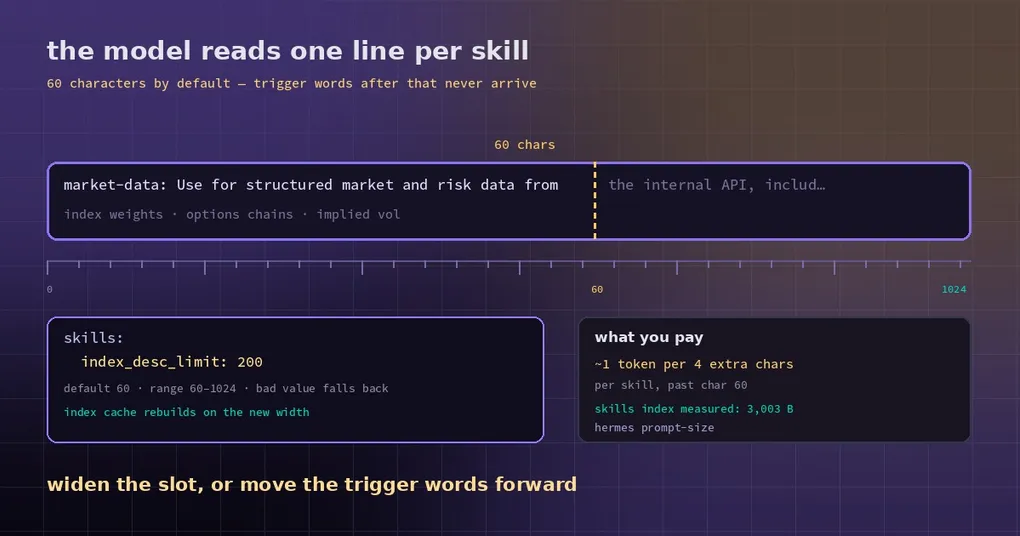
You wrote a careful skill description: purpose first, data source second, and — at the end — the part that actually matters, the sentence that says when to use it. Something like “for internal market and risk data, including index constituent weights, options chains and implied volatility surfaces”. Then you ask Hermes for an index weighting, and it does not load your skill. It goes to web search and comes back with stale second-hand numbers. You reread the SKILL.md and it clearly says what it does.
The description is fine. The model never read that half of it. In the system prompt every skill occupies exactly one line, name: description, and the description is clipped to the first 60 characters by default. Your trigger phrase, “index constituent weights”, sits at character 61 and simply is not there.
One line per skill is a budget decision
Hermes builds a skill index block into the system prompt: every available skill, one row each, so the model can decide which ones to load. That is a deliberate trade. Paste every full description in and a hundred skills eat thousands of tokens — on every single request.
The cost of that trade is positional: whoever writes the trigger words late gets clipped. Sixty characters of English is about a sentence and a half. Use for structured market and risk data from the internal... ends right there, and the API, the index weights, the options chains are all gone.
The row can be widened now
PR #158291 adds one setting:
skills:
  index_desc_limit: 200   # default 60; accepted range 60–1024
It changes more than the truncation, and each part matters:
| Situation | Default (60) | With 300 |
|---|---|---|
| Index row the model sees | a 151-char description cut mid-sentence | the whole description, trigger words included |
skill_manage creating a 96-char description |
refused: “must fit the 60-char skill index” | accepted; the schema says “max 300 chars” |
/learn and curator guidance |
“no more than 60 characters” | “no more than 300 characters” |
| How it cuts | at a word boundary, never half a word | same word-boundary rule |
A few implementation details explain what you will and will not notice:
- The width is read on every call. In a multiplexed gateway each profile gets its own width, so raising profile A to 300 does not change what profile B sees.
- The cache is keyed on the width. The on-disk skills snapshot and the in-process index cache both rebuild when the number changes — otherwise rows kept showing the old clip until some SKILL.md happened to change.
- A bad value does not raise. Something non-numeric falls back to 60.
- Bundled skills are untouched. They still follow the 60-character authoring standard (
skills/AGENTS.mdsays the user setting never relaxes it). What you widen is your own skills.
What it costs, and how to check
Every extra character goes into the system prompt. The official estimate is plain: roughly one token per four extra characters, counted per skill, and only for descriptions that run past 60 characters. The rows sit in the cached prefix, so later calls hit cache instead of paying full price again.
To see what you are spending:
hermes prompt-sizeOn a working profile that runs this site’s operations job, the measured breakdown put skills index at 3,003 B inside a 47,911 B system prompt:
  System prompt total :   47,911 B  (46.8 KB, 37,189 chars)

  Major blocks:
    skills index       :    3,003 B  (2.9 KB)
Install more skills and raise the width from 60 to 300, and that block grows noticeably. That is the moment to ask the real question: does the index need to be longer, or do the skills need merging and the descriptions rewriting?
hermes skills list shows name, category, source and status for what you have installed; hermes config get skills dumps the whole skills section, where an absent index_desc_limit means 60. Command details: hermes skills and hermes prompt-size.
Rewrite the description before raising the limit
Honestly, the 60-character limit is a writing discipline. It forces “what is this for” to the front. Plenty of clipped skills do not have a budget problem — their first sentence is background, not a trigger.
So the order is: move the trigger words inside the first 60 characters, then consider widening. If a skill genuinely needs four parts — purpose, source, when to use it, when not to — with proper nouns all over the place, that is exactly what this knob is for.
Two caveats. A longer description does not guarantee the right skill gets picked; name and description are hints, and the body is what the model actually reads once skill_view hands it over. We covered the other half of that in the truncated skill_view preview: the index earns the look, the body has to arrive intact. And if you are squeezing prompt size in general, the approach in the tool schema diet applies here too — measure first, cut second, tune parameters last.
Can you use it today
Only from main. The PR merged on 2026-11-20, after the v0.23.3 tag, so no released build has it. It is a pure config addition with no schema migration and no behaviour change at the default, which makes waiting for the next release the low-risk choice.
Update (2026-11-25): these changes shipped in v0.23.4 (November 24) —
hermes updatebrings them in. The “not in v0.23.3 / onmainonly” wording above is a snapshot from publication time.
Short version: the skill index is a row of ad slots, 60 characters each. Do not put the trigger words outside the slot — move them forward, or widen the slot. Both work; the first one is free.