Your Kanban Card Sat in Ready All Morning: One Dry Run Names the Guard
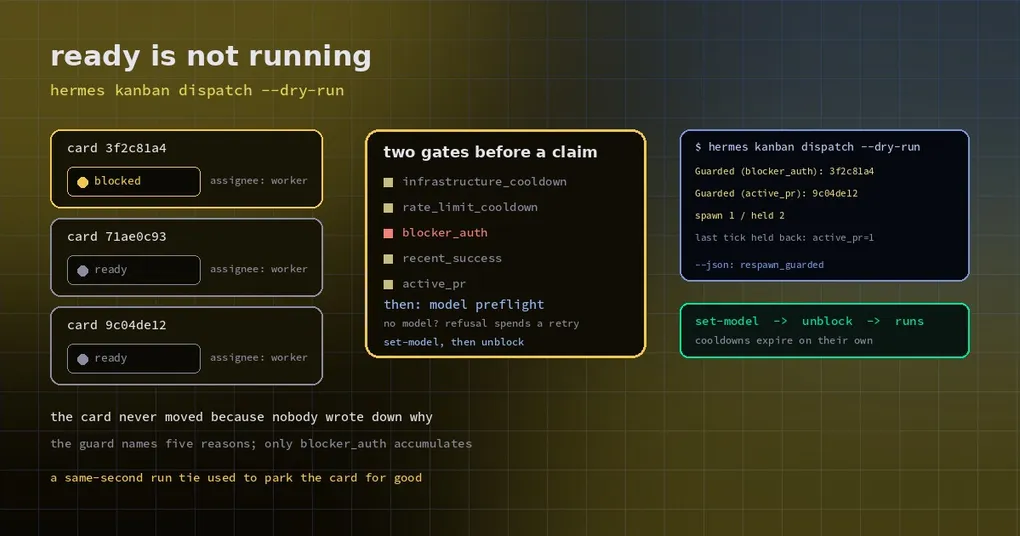
Nine in the morning: you open the board and three cards sit neatly in the ready column. Nine ten: still sitting there. The worker log is empty. Nothing happened. The gateway log has one line — Last tick held back: active_pr=1 — and you cannot tell which card it means or why.
Ready does not mean “will be picked up”. Every dispatcher tick passes the card through a respawn guard, then a model preflight, and if either one says no, the card stays put. Most of the time, neither one says anything out loud.
Gate one: the respawn guard reads the last runs
The guard runs before any claim. It looks at how the card’s recent runs ended, and there are five reasons it will hold a card:
| Reason | What happened | Counts against the card |
|---|---|---|
| infrastructure_cooldown | The host refused the last spawn (no restart-safe systemd scope) and the cooldown has not elapsed | No |
| rate_limit_cooldown | The last run hit a quota wall and was requeued | No |
| blocker_auth | The last failure was a quota, auth or 429 error | Yes, until the breaker blocks it |
| recent_success | A run completed successfully within the last hour; wait for review | No |
| active_pr | A GitHub PR link appears in a recent comment; a re-run risks a second PR | No |
The first two share one cooldown window, HERMES_KANBAN_RATE_LIMIT_COOLDOWN_SECONDS (300 seconds by default), and are deliberately never counted as failures — they mean infrastructure told you to wait, not that the card is broken. The review lane skips recent_success and active_pr: those two are inputs to a review handoff, not reasons to refuse one.
Stale or dead claim locks are not a guard reason either. That is what reclaim is for.
One command: dispatch –dry-run
hermes kanban dispatch --dry-run
hermes kanban dispatch --dry-run --json
The human-readable output lists each held card on its own line: Guarded (blocker_auth): 3f2c81a4. In --json the matching keys are respawn_guarded, rate_limited, skipped_locked and memory_pressure.
The gateway’s and the standalone daemon’s “dispatcher stuck” warning carry the same information for the last tick — Last tick held back: active_pr=1 — so even without the dry run you get a direction.
Gate two: the model preflight refuses before the spawn
To run a card, the dispatcher must first know which model it runs. It reads the assignee’s effective config, in this order:
- the model pinned on the card (
--model); - the profile’s
model.default(or the welcome trial model); - the model the named endpoint carries;
- the provider catalog’s default.
auto, and a self-hosted endpoint on loopback, a LAN, a tailnet or a private-use name, stay empty and are left for the turn to resolve — exactly as the gateway does. The preflight probes no credential and contacts no server; it reads config.
If none of that resolves a model, the preflight refuses: the reason goes into the card’s worker log and the attempt counts as a failure. The refusal names both remedies — pin a model on the card, or configure the profile:
hermes kanban set-model <task-id> <model>
hermes -p <profile> model
One detail bites people: a refusal spends the retry budget. Once the card has been auto-blocked, setting a model alone does not re-run it — you have to unblock it:
hermes kanban unblock <task-id>Two edges just fixed: the qwen alias and self-hosted base URLs
PR #158834 closed a gap between what the preflight judges and which provider the turn actually runs.
provider: qwenresolved two different ways. In the catalog, the aliasqwenpoints atalibaba; the turn’s own resolver runs it asqwen-oauth. So a card with no model was judged to be on Alibaba’s catalog default (qwen3.8-max) and then ran on Qwen OAuth. The preflight now takes the built-in provider from the turn’s resolver; across 274 provider spellings,qwenis the only one where the two disagree.- Three base URLs read by their own resolvers.
HERMES_CODEX_BASE_URL(openai-codex),NOUS_INFERENCE_BASE_URL(nous) andHERMES_QWEN_BASE_URL(qwen-oauth) are read by each provider’s resolver rather than the registry’sbase_url_env_var. If you pointed one of those at your own server, the preflight did not know it was local, asked for a public default model, and held the card. Those URLs are now candidates too.
Two runs in the same second: why the guard read the older one
PR #158829 fixes a race that only exists inside one second.
To judge blocker_auth, the guard takes the card’s latest finished run with ORDER BY ended_at DESC LIMIT 1. Run end times are whole seconds. If one tick reclaims a stale claim and, in that same second, the card’s spawn is refused by a config-plane 403, both rows share an ended_at, the ordering falls back to scan order, and the guard reads the older reclaimed row. It then misses the 403 deferral, and blocker_auth matches the auth wording inside that 403 and parks the card for good.
The fix breaks the tie by id, so the later insert wins. Two lines — and a good explanation of why “it gets stuck once in a while” is the hardest kind of report to chase: the condition needs two events inside the same second.
The order to debug in
When a card sits in ready, work down this list:
hermes kanban dispatch --dry-run— read the Guarded lines and the reason class first;hermes kanban show <task-id>andhermes kanban runs <task-id>— see how the last runs ended and what they said;hermes kanban set-model <task-id> <model>— pin a model when one is missing or the preflight refused;hermes kanban unblock <task-id>— after the card has been auto-blocked;hermes kanban reclaim <task-id>— when a claim is stuck on a dead process (this is not a guard reason);hermes kanban diagnostics— for any other active diagnostic on the board.
Status: both fixes are on main
#158834 (provider and base-URL judgement) and #158829 (the same-second ordering) merged between November 19 and 22 and live on main — not in v0.23.3. The same window also carries a fix that retains unverifiable app-pinned status evidence during acceptance, which is a separate concern from dispatch judgement.
Update (2026-11-25): these changes shipped in v0.23.4 (November 24) —
hermes updatebrings them in. The “not in v0.23.3 / onmainonly” wording above is a snapshot from publication time.
dispatch --dry-run itself predates both, so you can use it to investigate today.
The one-paragraph version
A card that does not move is rarely a broken card: read the Guarded line, then check whether the card’s model resolves. The two cooldowns pass on their own, blocker_auth accumulates until the breaker blocks the card, and recent_success and active_pr are waiting on a person — on your review, or on you finishing the PR.
If you have not set up the review lane yet, start with the Kanban review lifecycle; for the model chain behind the preflight, fallback check has the commands.