Hermes Agent Error Handling and Recovery: A Deep Dive
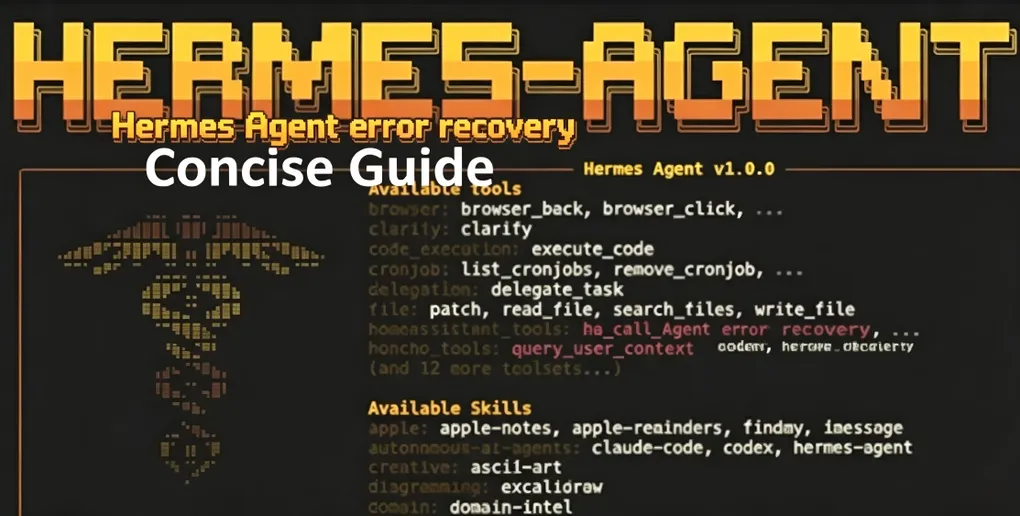
When LLM agents move from prototypes to production, the most dangerous failures are rarely wrong answers. They are the 2 a.m. crashes caused by a 429 error, an overlong log, or an expired API key. Many frameworks leave that to the developer’s try/except block. Hermes Agent bakes recovery directly into the runtime.
This article breaks down Hermes Agent’s six-layer resilience stack: error classification, adaptive retry, provider fallback, context compression, checkpoint rollback, and session recovery. You will see exactly how Hermes picks itself up when something goes wrong.
1. Classify First, Decide Second: The Error Classifier
Hermes routes every API error through classify_api_error() in agent/error_classifier.py. It does not treat every exception as a generic network problem. Instead, it maps each failure to a concrete FailoverReason: rate_limit, overloaded, context_overflow, payload_too_large, long_context_tier, auth, billing, content_policy_blocked, ssl_cert_verification, timeout, stream_drop, thinking_signature, model_incompatible, and invalid_request.
Each reason carries three flags: retryable, should_fallback, and should_compress. The recovery loop acts on these flags, not on the raw error text. That makes the strategy predictable, testable, and extensible.
2. Adaptive Retry: Read Retry-After, Not Just Sleep
Hermes implements adaptive_rate_limit_backoff() in agent/retry_utils.py. It is not a naive exponential backoff. It:
- Reads the HTTP
Retry-Afterheader. - Caps wait time at 600 seconds so a provider cannot block a session forever.
- Uses special long/short backoff policies for Z.AI coding overload.
- Adds jitter so multiple Hermes instances do not thunder back to the provider at the same instant.
During the retry loop, Hermes prints a compact status block: error type, provider, model, elapsed time, context size, and countdown. That transparency is essential when debugging 24×7 gateways or cron jobs.
3. Provider Fallback: From Local Retry to Cross-Provider Escape
Hermes does not stare at a single provider. It chooses the path based on the error type.
- Transparent local retry: For connection drops, 5xx, and 408, it retries on the same provider several times.
- Auth refresh and credential pools: For
autherrors, it refreshes credentials, renews the Nous Portal runtime, and rotates keys if a pool is configured. - Billing and rate limits: The current provider is marked
unhealthy, and the fallback chain activates: first the customfallback_chain, then globalfallback_providers, then the internal auto-discovery chain. - Content policy: For
content_policy_blocked, it does not retry; instead, it gives the user a clear course of action.
For Nous Portal 429s, Hermes writes a cross-session rate_limit record so all workers avoid hitting the same exhausted bucket. That protects high-concurrency, long-running deployments.
4. Context Compression: Turning “Context Explosion” into Routine
The most common failure in long LLM conversations is exceeding the context window. Hermes handles this with unusual precision:
- Output-cap errors: When
max_tokensexceeds the provider’s model limit, the user is prompted to lowermodel.max_tokenswithout wasting retries. - Input-too-large: Hermes extracts the real limit from the error message, updates the compressor’s
context_length, and compresses the messages. - Minimax special case: When the provider only reports “exceeded by X tokens,” the original window is kept and compressed.
Compression is not one-shot: first messages are summarized, then image payloads are stripped from tool messages, and only then is the user prompted to /new or /compress. For Anthropic long-context-tier errors, the window is temporarily reduced from 1M to 200K and compressed without persisting the downgrade.
5. Checkpoints and Rollbacks: Insurance for Files and State
Hermes includes a filesystem checkpoint manager in tools/checkpoint_manager.py. At any time, /rollback can list available checkpoints and restore them. For refactors, config changes, or batch file operations, this is a lightweight undo layer.
Snapshots go further:
/snapshot create before-major-refactor
/snapshot restore 20260717_142030
/snapshot prune 10
/snapshot stores Hermes configuration and runtime state, while /rollback backs up working-directory files. Together they cover both state and files.
6. Session Recovery: Seamless Handoff Between CLI and Telegram
Hermes persists every conversation in a SQLite database at ~/.hermes/state.db, including full message history, tool calls, token counters, system-prompt snapshots, timestamps, and parent session IDs. That means:
hermes --continueorhermes -r <session_id>resumes the last CLI session./new payments-refactornames a session, and/resume payments-refactorretrieves it later.- Sessions can hand off across platforms: start in the CLI, continue on Telegram, then resume on the desktop with
/resume.
When restoring, Hermes shows a compact summary so you do not have to reread the entire thread. Long sessions can be kept under control with /compress.
7. Emergency Command Reference
| Command | Function |
|---|---|
/retry |
Resend the last message. |
/resume [name] |
Resume a previous session. |
/new [name] / /reset |
Start a new session, optionally named. |
/compress [here [N] | focus topic] |
Manually compress context. |
/undo |
Remove the last user/assistant exchange. |
/rollback [number] |
List or restore a filesystem checkpoint. |
/snapshot create/restore/prune |
Save, restore, or prune snapshots. |
/stop |
Stop all background processes. |
hermes --continue |
Resume the last CLI session. |
hermes -r <id> |
Resume a session by ID. |
hermes -c "name" |
Resume a session by name. |
8. Comparison with Common Frameworks
| Capability | Hermes Agent | OpenAI Agents | AutoGen/AG2 | CrewAI | LangGraph |
|---|---|---|---|---|---|
| Error classification | Built-in FailoverReason |
SDK base errors | Simple | Tool-level | Design yourself |
| Automatic provider fallback | Built-in fallback chain | Manual implementation | Partial | Not supported | Manual implementation |
| Context compression | Built-in multi-stage | Not supported | Not supported | Not supported | Not supported |
| Session persistence/recovery | SQLite + /resume |
Save yourself | Save yourself | Not supported | State-machine checkpoint |
| Filesystem checkpoints | /rollback |
Not supported | Not supported | Not supported | Not supported |
| Cross-platform handoff | Built-in | Not supported | Not supported | Not supported | Not supported |
The difference with Hermes: error handling is not an optional plugin, but part of the agent runtime. You do not write try/except blocks, maintain provider lists, or manually trim context. All of that is default behavior.
9. Practical Recommendations for Engineering Teams
- Configure a fallback provider. Have at least one in production so 429 and 402 errors do not turn into midnight alerts.
- Name important sessions. With
/new <task-name>, you can later/resumeand switch between platforms. - Create snapshots before big changes.
/snapshot create <label>enables quick rollback. - Use cron
no_agentfor repeatable tasks. For recurring, critical jobs,no_agent: truecron scripts with direct stdout avoid the uncertainty of LLM inference. - Back up
~/.hermes/state.db. Your entire conversation history lives there.
Conclusion
Hermes Agent’s error-handling system is far more than “retry a few times and give up.” It attacks the most common failure modes of LLM operations from six directions: classification, retry, fallback, compression, checkpoints, and session recovery. For teams that want to run agents in production, that self-healing ability is just as important as the model’s reasoning capability itself.
If you are still writing ad-hoc scripts for provider outages, context bloat, or model switching, let Hermes do the dirty work. Configure your fallback, hit /resume, and keep going.